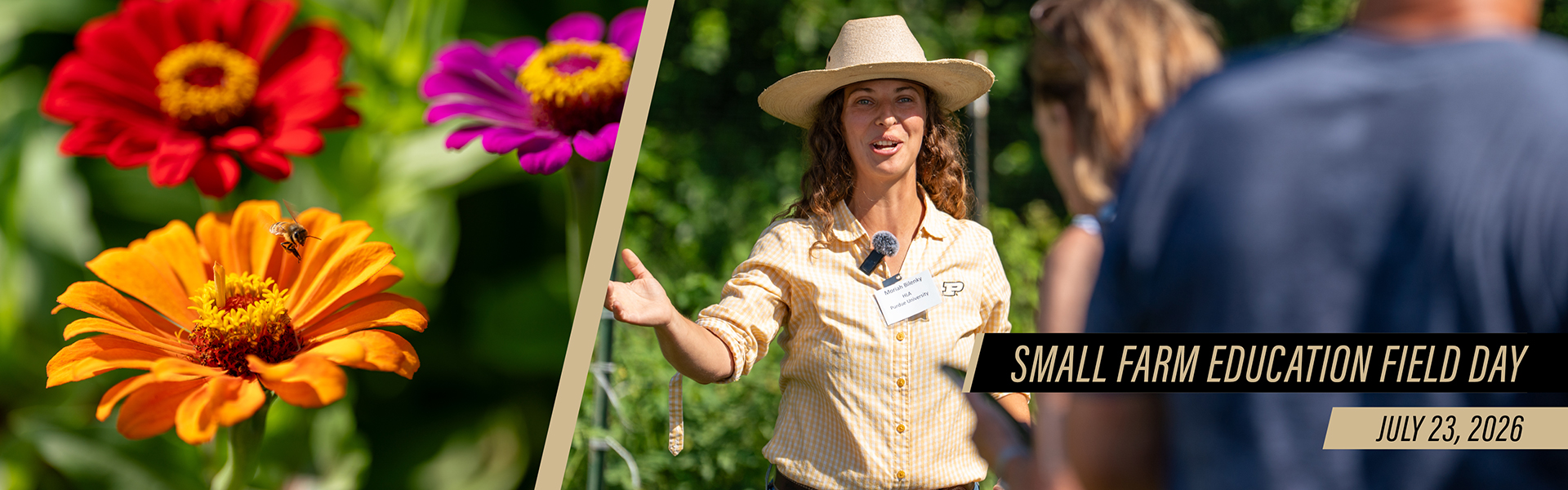
2026 Purdue Small Farm Education Field Day
Join us for the Small Farm Education Field Day on July 23, 2026, at the Purdue Student Farm in West Lafayette, where you’ll learn from Purdue experts through hands-on demonstrations and presentations on topics including flower production, high tunnel production and management, integrated pest management, food safety, and vertical container farming, among others. This event brings together small farm operators and urban growers from across Indiana to exchange practical knowledge and discover proven techniques to improve the productivity and sustainability of their operations. Register now to secure your spot at this valuable learning and networking opportunity.
REGISTRATION FOR THE 2026 FIELD DAY IS NOW OPEN!
The 2026 schedule is now available.
Registration is between 8:00 and 9:00 AM. The program will start with a 1-hour flower demonstration followed by six 20-minute demonstrations. If you have any questions, contact Lori Jolly-Brown at 765-494-1296 or email her.
Flower Production
Presenters: Tara Watkins, University of KY. Laura Ingwell, Entomology, Wenjing Guan, Horticulture & Landscape Architecture. Jayde Grisham, Purdue Extension
Cut flower production can be a profitable addition to any small farm or a standalone farm business. To better serve cut flower growers in the state, a team of Extension educators and specialists has come together to demonstrate different cut flowers in Indiana production systems. In this presentation, we will cover the basics from seed to selling, utilizing a few species in our demonstration. We will discuss seeding strategies, planting density, the benefits of protected culture, insect and disease incidence and management, and harvesting, marketing, and sales.
Managing Root-Knot Nematodes in High-Tunnel Tomato Production Using Microbial Approaches
Presenters: Vijay Kunwar, Chenmi Mo, and Lei Zhang, Botany and Plant Pathology. Wenjing Guan, Horticulture & Landscape Architecture
High-tunnel tomato production helps small farms extend the growing season and improve crop quality, but it can also create favorable conditions for root-knot nematodes (RKNs). Warm soil temperatures, consistent moisture, and repeated tomato production can allow these plant-parasitic nematodes to build up over time. RKNs damage tomato roots by causing galls, which can reduce water and nutrient uptake and lead to stunting, chlorosis, poor plant growth, and yield loss.
Mushroom Production Using Logs: How to prepare and inoculate logs with mushrooms
Presenter: Chris Adair, Horticulture & Landscape Architecture
Growing mushrooms on logs is one of the most accessible and rewarding practices a small-scale producer can add to their operation. Whether you’re looking to diversify your farm’s product mix, make use of wood from timber stand improvement, or simply explore a low-input, high-value enterprise, log-grown mushrooms offer a compelling opportunity. In this demonstration, we’ll walk through the complete process of selecting and preparing suitable logs, choosing the right mushroom species for your goals, and inoculating logs using plug or sawdust spawn. By the end, you’ll have the practical knowledge and confidence to take this technique home and get started on your own farm.
Low Tunnel Construction Grow Longer, Grow Smarter: Choosing, Building, and Managing Season Extension Structures for Small Farms
Presenters: Petrus, Alex Snabes, Horticulture & Landscape Architecture. Nathan Shoaf, Purdue Extension
Season extension is one of the most accessible tools available to small-scale vegetable producers, yet selecting and managing the right protected cultivation system requires careful consideration of scale, budget, and production goals. This demonstration will guide growers through practical options for low tunnel construction and management, including how to bend your own hoops with a hoop bender and readily available hardware store materials, as well as commercially available wire products such as the Lowcat tunnel. Participants will see firsthand which tools and materials are needed, how structures are assembled in the field, and how to evaluate which approach best fits their operation’s scale, budget, and production goals. Practical strategies for maintaining structures, extending their lifespan, and managing the protected environment for vegetable production will also be covered. Whether aiming to transplant earlier, protect crops from frost or insect pests, or extend harvest into the fall, attendees will leave with the hands-on knowledge to build, source, and manage low tunnel season-extension systems on their farms.
Scouting: An Essential Part of an IPM Program: Tools and Technologies for Insect Scouting and IPM
Presenter: Laura Ingwell, Entomology
In this presentation, we will review some of the best tools and technology platforms to help assist you in your insect management programs. With a focus on high tunnel production systems, we will review what to watch for (friends and foes) and demonstrate how to integrate iNaturalist as your digital record book and diagnostic assistant.
Tarpin’ Taters
Presenter: Steve Meyers, Horticulture & Landscape Architecture
Silage tarps are one method of weed management used on small farms, but their use for weed suppression in potatoes has not been fully explored. At this stop, we’ll present data we’ve acquired over the last four growing seasons on the best way to use silage tarps for early-season weed management in potatoes.
Postharvest Produce Sanitation and Rinse Conveyor Rinse for Results: Cleaner Produce, Longer Shelf-Life
Presenters: Amanda Deering, Scott Monroe, Entomology, Chris Adair, Horticulture & Landscape Architecture
Fresh fruits and vegetables can carry surface bacteria that reduce safety and shelf life. Using a vegetable washing system with an approved sanitizer helps remove dirt, debris, and harmful microorganisms such as E. coli and Salmonella. This process reduces surface contamination, slows spoilage, and helps maintain freshness and quality during storage. Proper washing and sanitizing systems are important postharvest practices for improving produce safety, extending shelf-life, and reducing food waste.
After lunch on-demand demonstrations:
Building Ag Resources through black soldier fly rearing
Presenter: Laura Ingwell, Entomology
Join us for a demonstration of how you can integrate black soldier flies into your small farm to help recycle organic wastes into two important basal agricultural resources: fertilizer and feed.
From Field to Vase: Market Morning Blooms
Presenter: Macon Beck , Horticulture & Landscape Architecture
Join us for a relaxed, hands-on demonstration using freshly cut, field-grown flowers, where you’ll learn how to turn simple stems into a charming, natural arrangement. Along the way, we’ll share practical tips on caring for your stems from harvest to vase and explore thoughtful, sustainable approaches to working with seasonal blooms.
Choosing the Right Sweet Pepper Varieties for High Tunnel Success in Indiana
Presenters: Petrus Langenhoven, Alexandria Snabes, Horticulture & Landscape Architecture
This presentation examines the critical factors influencing successful sweet pepper production in high tunnel environments, with a particular focus on variety selection for Midwestern growing conditions. Since 2018, our research team has conducted comprehensive evaluations of over forty sweet bell and tapered pepper varieties to identify those best suited for protected cultivation. We will present detailed performance data from the 2025 growing season at the Purdue Student Farm in West Lafayette, IN, highlighting colored sweet pepper varieties – including both bell and tapered types. Production metrics, disease resistance, yield potential, and quality characteristics will be analyzed to provide growers with actionable insights for their operations. Additionally, we will introduce the current selection of pepper varieties being cultivated in our 2026 trials, discuss the criteria that informed these choices, and share early observations of their performance. Attendees will gain practical knowledge about high tunnel management techniques that optimize growing conditions for sweet peppers, enabling them to extend their production season and protect crops from adverse environmental conditions. This presentation will benefit market gardeners, commercial growers, and agricultural educators.