Category: Uncategorized

Fertility for the Southwest Purdue Agricultural Center Tomato Trial

​ Last year at the Southwest Purdue Agricultural Center (SWPAC) we conducted a tomato high tunnel trial described here. In this article, I would like to talk about the trial we will conduct in 2015, a repeat of the 2014 trial. In particular, I would like to talk about what we have done for fertility….Read more about Fertility for the Southwest Purdue Agricultural Center Tomato Trial[Read More]
Cucurbit Production in Indiana: 1925 and 2013

In December 2014, I described the ‘Yearbook of Agriculture, 1928”. In that blog, I wrote about processing tomato production in 1925 and 2013 (the ‘Yearbook of Agriculture, 1928’ lists data back to 1925). Today, I would like to discuss cantaloupe and watermelon production. Unfortunately, yields posted in the “Yearbook” are in different units than in…Read more about Cucurbit Production in Indiana: 1925 and 2013[Read More]


How Many Staked Tomatoes Should I Put in My High Tunnel?

Over the last several years, the number of questions I have had about tomato production in high tunnels has increased dramatically. Since I am a plant pathologist, most of the questions I have been asked are about diseases of tomatoes in high tunnels. However, I also have been asked production questions. One particular question about…Read more about How Many Staked Tomatoes Should I Put in My High Tunnel?[Read More]


Indiana’s Processing Tomato Industry in 1928 and 2013.

While visiting my son in Lincoln, Nebraska this past summer, I had the chance to browse in a second hand store.I felt myself drawn to the book section where I found a green hard cover book titled, “Yearbook of Agriculture, 1928”. From 1894 until 1992, the Department of Agriculture published a Yearbook of Agriculture annually….Read more about Indiana’s Processing Tomato Industry in 1928 and 2013.[Read More]


An Update on the Use of Copper Products for Managing Bacterial Spot of Tomato

​For 100 years bacterial spot has been causing huge losses for tomato ​growers worldwide. For 100 years products containing copper have held the key to controlling this devastating tomato disease. As tomato growers enter their second century of dealing with bacterial spot, the question has become whether copper applications lessen the severity of bacterial spot-or…Read more about An Update on the Use of Copper Products for Managing Bacterial Spot of Tomato[Read More]


Tomato Fruit Lesions

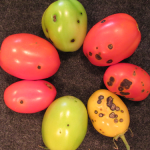
​The photos that accompany this article are of lesions caused by various diseases that occur on tomato fruit. The list includes diseases I commonly see in Indiana, so the list is not all inclusive. More information can be found on the Purdue Tomato Doctor​ app​. I welcome any comments or questions. Bacterial spot of tomato….Read more about Tomato Fruit Lesions[Read More]


Late Season Fusarium Wilt of Watermelon

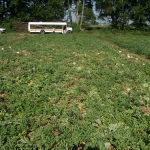
Over the past few weeks, I have observed several watermelon fields with relatively large areas of wilted plants.There can be several reasons for such symptoms.In the article below, I will discuss late season Fusarium wilt of watermelon.In a separate article, I will discuss mature watermelon vine decline.In a separate article/blog I discussed root knot nematode.All…Read more about Late Season Fusarium Wilt of Watermelon[Read More]


Preparing for Freezing Temperatures in the Tomato High Tunnel

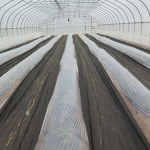
​The low tonight is forecasted to be 28 F. In preparation, we placed clear plastic over each row. This type of plastic is not vented. Therefore, one must be very careful to watch the temperature inside the tunnel when there is direct sunlight. Although we made it through last night, tomorrow morning will be the…Read more about Preparing for Freezing Temperatures in the Tomato High Tunnel[Read More]


Page last modified: April 11, 2019

Vegetable Crops Hotline - Horticulture & Landscape Architecture, 625 Agriculture Mall, West Lafayette, IN 47907

© 2026 Purdue UniversityAn equal access/equal opportunity universityCopyright ComplaintsMaintained by Vegetable Crops Hotline

If you have trouble accessing this page because of a disability, please contact Vegetable Crops Hotline at plangenh@purdue.eduAccessibility Resources