Weed management can succeed or fail based on a number of factors. In the last issue of Vegetable Crops Hotline, we began assessing weed control and the effects of rainfall and soil moisture on weed management. In this article, we’ll take a deeper look into herbicide resistance and tolerance.
Herbicide tolerance is the inherent ability of a plant species to survive a normal use rate of a herbicide. Most herbicides have a “sweet spot” in the types of weeds that they control. Meaning that, for any given herbicide, there are many weed species that are only suppressed or not controlled at all. Some examples of herbicide tolerance are very obvious. If you apply clethodim (a WSSA Group 1 herbicide) to grass and broadleaf weeds, it will only kill the grasses because clethodim is a “grass-selective” herbicide. The opposite is true for synthetic auxin herbicides (WSSA Group 4), such as 2,4-D, which are active only on broadleaf plant species. But herbicide tolerance can be more subtle. For example, soil-applied Command herbicide (clomazone) works well on velvetleaf but is weak on pigweeds. Soil-applied Dual Magnum herbicide (S-metolachlor) works well on pigweeds, but will not control lambsquarters. Sometimes tolerance is tied to weed seed size. Many soil-applied herbicides are “effective against small-seeded grasses and broadleaf weeds” while providing little to no control of larger-seeded weed species. One way to explore herbicide tolerance is to examine herbicide efficacy tables, such as those in the Midwest Vegetable Production Guide (Figure 1).
If you find yourself saying “this herbicide has never provided good control of this weed”, what you are observing is likely herbicide tolerance.
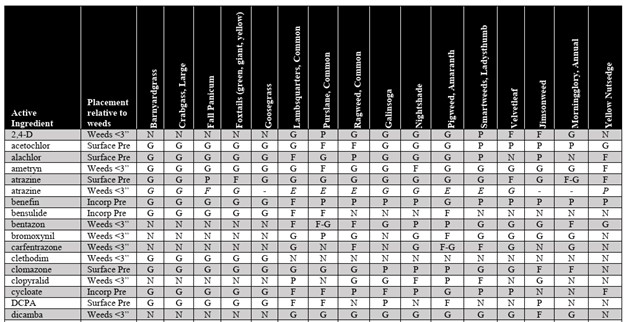
Figure 1. An example of a herbicide efficacy table taken from the 2026 Midwest Vegetable Production Guide. Control is rated as – (unknown), N (none), P (poor), F (fair), G (good), or E (excellent).
Herbicide resistance is the inherited ability of a plant to survive a herbicide application that would typically kill plants of the same species. The repeated use of the same herbicide or herbicides with the same mode of action can select for individual weeds that survive these applications. If those plants survive, continue to grow, and set seeds, a portion of those seeds will inherit this herbicide-resistance trait. Over time, the population of that weed species will shift toward resistance, rendering once useful herbicides ineffective. The number of unique herbicide-resistant plant species globally has increased linearly since the 1970s (Figure 2). Additionally, weeds can develop resistance to multiple herbicides in the same mode of action (“cross resistance”) and to herbicides of different modes of action (“multiple resistance”).
If you find yourself saying “this herbicide used to provide good control of this weed, but it doesn’t control it now”, what you are observing is likely herbicide resistance.
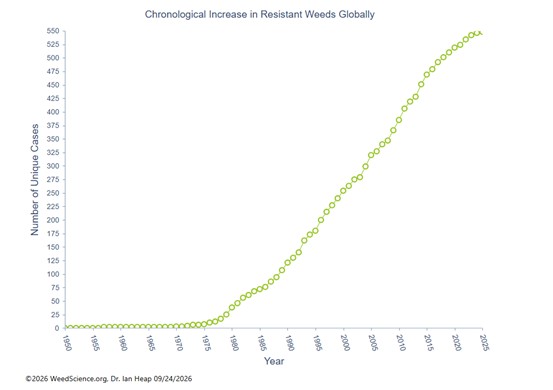
Figure 2. Number of unique herbicide-resistant plant species globally.
Other considerations: Related to herbicide resistance and herbicide tolerance in weedy plants is the herbicide resilience of a soil. Many herbicides are degraded by bacteria in the soil. Repeated application of herbicides can “prime” the soil by encouraging a shift in soil microbes toward those that break down herbicides. The most studied example is atrazine. When atrazine is applied to a field for 5 or more growing seasons, the length of its residual weed control is greatly reduced. For example, researchers in Tennessee reported that soils with no history of atrazine have a half-life of 17 days. However, the half-life of atrazine in soils with a history of atrazine use ranged from 3 to 11 days. While atrazine is the most common example, this condition may also apply to other herbicides as well.