As the growing season picks up, high tunnel growers planning to cultivate tomatoes should keep an eye out for the small but mighty tomato pinworm, Keiferia lycopersicella (TPW). The adult moths are up to 6 mm in length, with mottled brown spots (Fig. 1). They are active at night and remain hidden, resting on foliage during the day and are rarely seen. TPW primarily feeds on tomato plants but has occasionally been reported on other plants within the Solanaceae family, including but not limited to peppers, eggplant, and potatoes. The adults do not feed on tomatoes at all, but their larvae feed voraciously on the leaves. They create characteristic blotchy leaf mines and prefer leaf material, but may burrow into plant stems and fruits if leaves are too damaged.
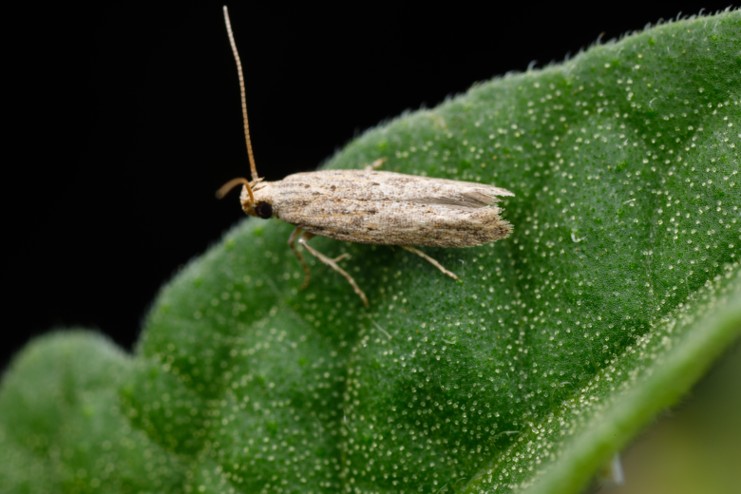
Figure 1. Adult tomato pinworm on a tomato leaf (Photo by Chris Wirth).
Adults lay small, pale-yellow eggs (Fig. 2) on the underside of tomato leaves that darken to orange before hatching. The larvae emerge and immediately start to feed between outer layers of the tomato leaf, creating distinct damage patterns as they grow (Fig. 3). As early instars, they create small blotchy mines that should not be confused with mines left by the leaf mining fly, Liromyza sativae. TPW leave their frass at the entrance to the mine, whereas fly larvae like L. sativae deposit their frass throughout the mine and their mines are more narrow, winding paths on the leaf. As TPW larvae continue to grow and feed, the mines increase in size. After the larvae reach their third instar, they will emerge from the mines and use webbing to curl edges of leaves for further protected feeding. At this stage, the larvae may also use webbing to either knit two separate leaves together or create a protected barrier on the surface of the leaf. Once the larvae pupate, they oftentimes drop into the soil or pupate within their protected leaf area. They emerge as adults after 1-3 weeks to mate and lay eggs, thus completing their life cycle.
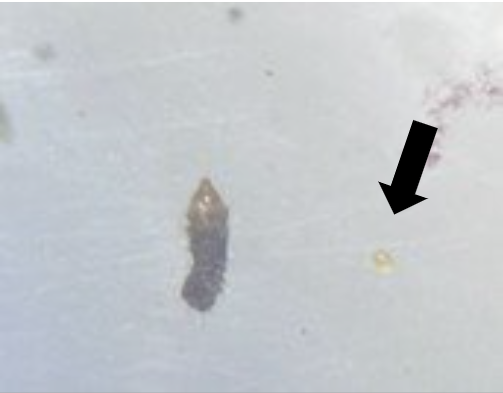
Figure 2. Tomato pinworm egg on the right, dead larva on the left. The egg is approximately 0.4 mm in length; you will likely never see them on your plants (Photo by Sydney Territo).
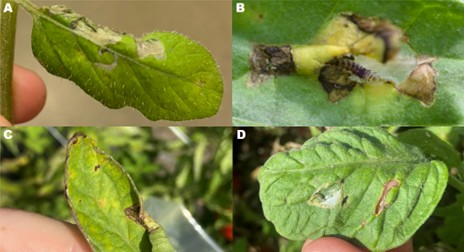
Figure 3. Tomato pinworm damage based on their life stage. Early instar larvae create small, winding mines (A) that become larger and blotchier as the larvae feed and grow (B). Late instar larvae curl leaves (C) using webbing, or may just use only webbing as a protective layer (D). All images except B taken by Sydney Territo. Image B taken by Hunter Roy.
The life cycle of TPW lasts for roughly 30 days but may vary depending on temperature. TPW experiences overlapping generations, which results in the various stages of life co-occurring throughout the growing season. They appear relatively early in the season in low numbers, but their populations grow exponentially; therefore, early detection and monitoring are incredibly important for managing their populations. Using wing traps (Fig. 4) lined with a sticky card and a pheromone lure is an easy method for monitoring adult activity. This will help coordinate your observations for larval damage to the plant parts. Start monitoring early and check your sticky trap often. We have captured adult TPW in HTs throughout Indiana from the months of March to November.
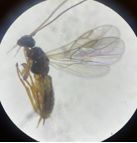
Figure 4. Hanging wing trap placed in a high tunnel (Photo by Sydney Territo).
While this pest is still relatively new or unnoticed in Indiana, if left unchecked, it can cause significant damage when feeding moves into the fruit. We have noticed in HT systems that pruning seems to be an effective tactic that may be inadvertently managing the population. If TPW is present, be sure to remove and destroy all pruned vegetation. If you are interested in augmentative biological control, Trichogramma egg parasitoid wasps are commercially available and can be purchased and released. The larval parasitoid wasp Parahormius pallidipes (Fig. 5) has been found in tunnels in West Lafayette, but it is not commercially available, and little is currently known about its native distribution or impacts on TPW populations. If you choose to use pesticides to manage TPW, refer to the Midwest Vegetable Production Guide and search under caterpillar pests in tomato to find recommendations. As these are internal foliage feeders, timing of applications and mode of action will have an impact on efficacy. If the product remains on the plant surface, the caterpillars will encounter a lethal dose at egg hatching and upon exiting the mine as 3rd-instar larvae. As always, when applying pesticides, follow the label as it is the law.
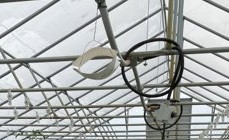
Figure 5. Larval parasitoid Parahormius pallipides (Photo by Cristhian Ochoa).
If you are interested in coordinating with our research group to monitor TPW populations on your farm, please contact Dr. Ingwell at 765-494-6167, lingwell@purdue.edu, or complete the Qualtrics survey. We look forward to working with you!