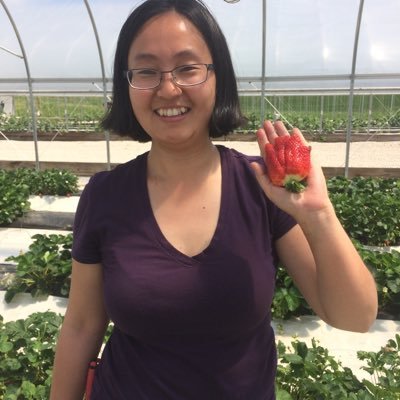

The annual Purdue Small Farm Education Field Day will be presented on July 29th from 9 am – 12 pm at the Purdue Student Farm, West Lafayette. Watch this newsletter and Purdue Extension social media for more information, or contact Petrus Langenhoven (765-496-7955, plangenh@purdue.edu) or Lori Jolly-Brown (765-494-1296, ljollybr@purdue.edu)
The Pinney Purdue Vegetable Field Day/Twilight Meeting will be held August 9, 2022 at 11402 S. County Line Road, Wanatah, IN. The evening program will feature plot tours for farmers and for homeowners featuring topics of irrigation, sweet corn, pumpkins, soil health and cover crops. An afternoon session for farm advisors and educators will include…Read more about Pinney Purdue Vegetable Field Day August 9, 2022 – Save the Date![Read More]
We received calls reporting observations of leaf curling on tomatoes. This article reviews factors contributing to the symptom. It was updated from an article published in June 2020, Issue 676. In a similar way as other vegetables, hot and dry conditions may cause leaf curling on tomatoes. In late spring and early summer, plants that…Read more about Tomato Leaf Curling[Read More]
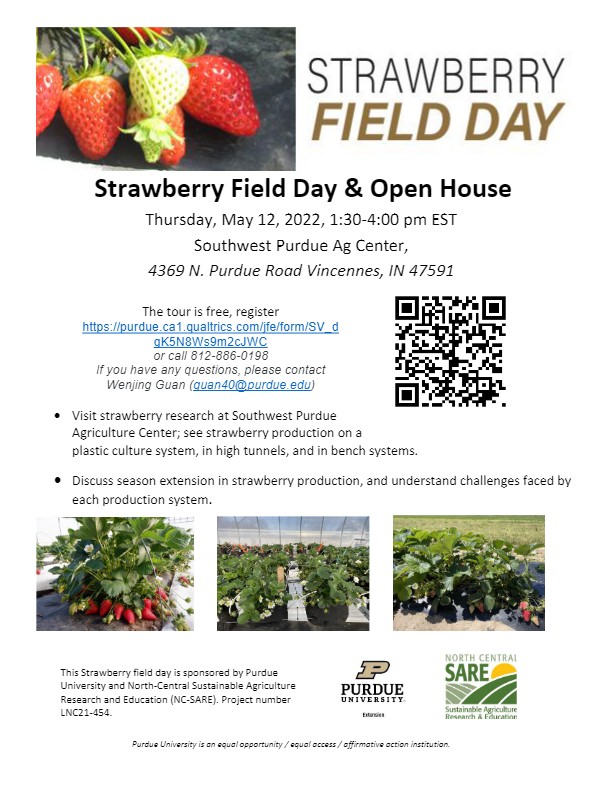
Time: Thursday, May 12, 2022, 1:30-4:00 pm EST Location: Southwest Purdue Ag Center, 4369 N. Purdue Rd, Vincennes, IN, 47591 Register: https://purdue.ca1.qualtrics.com/jfe/form/SV_dgK5N8Ws9m2cJWC, or call (812) 886-0198 Visit strawberry research at Southwest Purdue Agriculture Center; see strawberry production on a plastic culture system, in high tunnels, and in bench systems. Discuss season extension in strawberry production,…Read more about Strawberry Field Day[Read More]
Announcement from University of Illinois specialty crop entomology lab: We are monitoring for melonworms throughout the state this year! Last year, several of our pumpkin growers in the area had a late season infestation of caterpillars eating their pumpkins. The specialty crops entomology lab and U of I Extension are going to be investigating this…Read more about Melonworm Monitoring in Illinois Cucurbit Crops[Read More]
Time: Thursday, May 12, 2022, 1:30-4:00 pm EST Location: Southwest Purdue Ag Center, 4369 N. Purdue Rd, Vincennes, IN, 47591 Register: https://purdue.ca1.qualtrics.com/jfe/form/SV_dgK5N8Ws9m2cJWC, or call 812-886-0198 Visit strawberry research at Southwest Purdue Agriculture Center; see strawberry production on a plastic culture system, in high tunnels, and in bench systems. Discuss season extension in strawberry production, and…Read more about Strawberry Field Day[Read More]

Listen to Strawberry Chat Episode 2. The episode was recorded on April 6, 2022, it featured Dr. Bruce Bordelon talking about spring activities for the strawberry matted-row system. Are you interested in participating live in the next strawberry chat? It will be 12:00 -1:00 pm, May 4, 2022. Our guests will be Dr. Janna Beckerman…Read more about Strawberry Chat, April Episode Recording and May Episode Register[Read More]
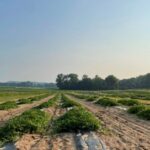
A large proportion of watermelon acres in Indiana are not currently using drip irrigation. Farmers may choose not to use drip irrigation because precipitation is usually abundant in most years for watermelon production. There is a desire to reduce costs and/or fear that over-irrigation may increase the risk of mature watermelon vine decline, a disease…Read more about Research Update on Nitrogen Management in Non-Irrigated Watermelon Production[Read More]
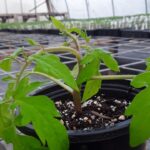
Tomatoes grown in a controlled environment are exposed to different conditions from their original habitats. As a result, some plants may respond to the controlled environment with abnormal symptoms. Leaf and stem curling and distortion are symptoms we may see in the early season in greenhouses (Figure 1). This symptom might be caused by ethylene…Read more about Leaf and Stem Curling on Young Tomato Plants[Read More]

Tell us about your opinions on vegetable grafting practices All growers are eligible whether you use vegetable grafting practices or not. Researchers at the University of Florida, in collaboration with Clemson University, North Carolina State University, The Ohio State University, Pennsylvania State University, Kansas State University, Washington State University, University of Arizona, University of California, Davis, and USDA – Agricultural Research…Read more about Vegetable Grafting Survey[Read More]