What’s Inside This Issue
As the growing season winds down, this issue covers both wrapping up this year and getting ready for next year.
High tunnel growers will find two timely reads. Summer heat inside a tunnel can work against the beneficial insects you rely on, and soil-dwelling nematodes may offer a better fit for biological control. Before you close up for the season, take a closer look at your tomato roots, because what’s hiding underground could affect next year’s crop.
Mint growers can catch up on recent herbicide label changes for Midwest production. If you’re interested in soil health and reduced tillage, learn what it takes to grow pumpkins with a cereal rye cover crop, and why planning starts this fall. A strong El Niño is shaping up for this winter, so see what past events have meant for Indiana.
Finally, don’t miss two upcoming learning opportunities. One is a free webinar on financing options for farm and food businesses. The other is a low-cost produce safety training held just before the Indiana Horticulture and Small Farm Conference (IHSFC). Save the date: the IHSFC runs January 26–28, 2027, at the Hendricks County Fairgrounds in Danville.
Looking Back at 2026
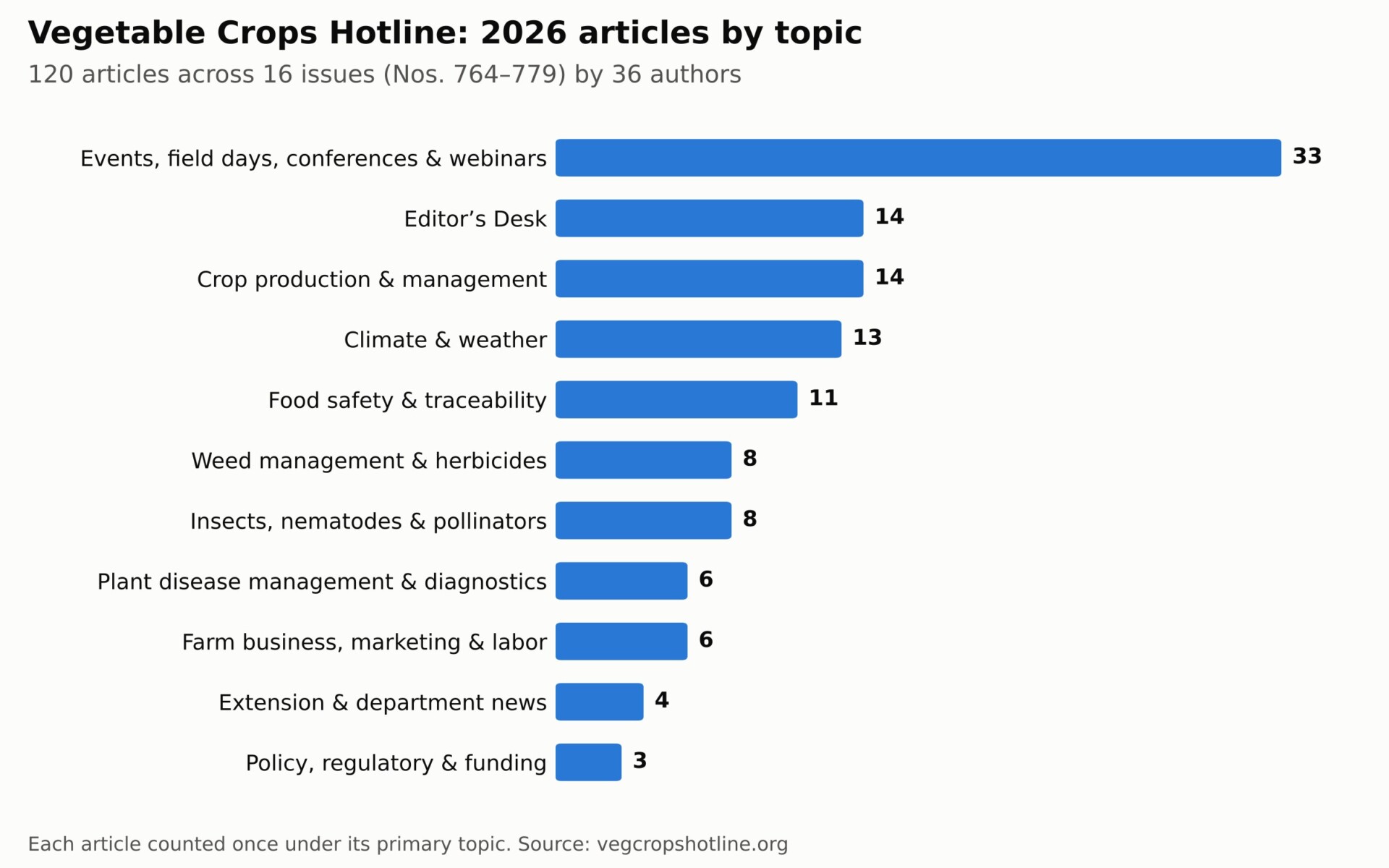
In 2026, the Vegetable Crops Hotline published 16 issues (Nos. 764–779, February 13 to September 25) with 120 unique articles. Thirty-six authors contributed, and we thank each for sharing their time and expertise.
Events and educational programming were the largest share, about 28% of content. The next largest groups were the Editor’s Desk, crop production and management, and climate and weather updates. Multi-author articles focused on pest, nematode, and pollinator research, as well as cut-flower and strawberry production. Among specific crops, cucurbits had the most coverage (watermelon, pumpkin, cantaloupe), followed by tomato, strawberry, and cut flowers.
Looking Forward
The Purdue Extension team in the Department of Horticulture and Landscape Architecture is combining the Vegetable Crops Hotline and Facts for Fancy Fruit newsletters into a single publication. This change has been coming for a long time. The two newsletters serve many of the same growers and often cover overlapping topics, such as events, food safety, weather, and pest updates, which has meant duplicated effort on both sides. A combined newsletter will let us consolidate that work and align our content publication with Purdue University’s ADA accessibility requirements. Our commitment to timely, research-based information for Indiana’s fruit and vegetable growers stays the same. We will share more details about the timeline, format, and subscription process as they become available. Thank you for your continued readership and support.
Midwest Vegetable Production Guide
The 2026 Midwest Vegetable Production Guide is available now, online or as a downloadable file you can print from your computer. The 2027 edition should be out by January 2027, so watch for an announcement on the Vegetable Crops Hotline website.
Midwest Vegetable Trial Report
Thinking about which vegetable seeds to buy? The Midwest Vegetable Trial Report has many articles to help you choose, along with production-related research results. New trial reports will be published in the fall and winter, so keep an eye out for the latest vegetable trial information as you plan for next season.
Contact Us If You Have a Story to Share
Growers and Purdue Extension educators, your input and expertise make this newsletter a useful resource. If you have hot topics you’d like us to cover, success stories to share, or questions for our Extension specialists, please email Petrus Langenhoven or contact the specialist directly. We also welcome high-quality photos of pest problems, unusual symptoms, or new production practices you’ve tried on your farm.
Extension educators and specialists: This is our last scheduled issue of the season, but we will keep publishing articles on the Vegetable Crops Hotline website until our first issue in February 2027. Please continue sending timely articles, event announcements, and field observations as you have them. We will post them as they come in, so growers have up-to-date information throughout the off-season.