Days ago, the Office of the Indiana State Chemist (OISC) approved expanded label language allowing an over-the-top application of Dual Magnum® herbicide on pumpkins in Indiana. This change follows extensive research conducted in 2021 across 11 sites in 10 states to confirm jack-o’-lantern pumpkin crop tolerance to this application. Full results from that research can be found here. Below, I break down the questions you might have about using Dual Magnum® herbicide over your pumpkins.
What is Dual Magnum® herbicide?
Dual Magnum® is a soil-applied, preemergence herbicide that provides residual control of small-seeded broadleaves and grasses as well as suppression of yellow nutsedge. This herbicide will not provide control of emerged weeds. Its active ingredient is S-metolachlor, a WSSA Group 15 herbicide. This herbicide is registered for many agronomic, fruit, and vegetable crops, with additional uses appearing on Indiana’s special local need (SLN) label.
What is the new labeled use?
The new use allows for Dual Magnum® to be applied in fields of emerged pumpkins. The use rate is 0.75 to 1.33 pints per acre. Pumpkins must be at least 4 inches tall for direct-seeded crops or at least 10 to 14 days after transplanting pumpkins. As with most soil-applied herbicides, use the lower rate on coarse-textured soils and the higher rate on fine textured soils. This application can be broadcast over the entire field or applied to the row middles only. The preharvest interval remains at 60 days.
However, there are limitations:
No more than 1.33 pints of Dual Magnum® (1.27 pounds of S-metolachlor) can be applied per acre per year. This means that if you applied 1 pint per acre of Dual Magnum® at planting, you only have 0.33 pints per acre left for the over-the-top application. In future pumpkin crops, you could consider removing Dual Magnum® from the at-planting application or splitting the rate between both application timings. For example, you might apply Strategy® and Reflex® at planting and Dual Magnum® over-the-top three weeks later.
Because Dual Magnum® does not control emerged weeds, emerged weeds should be controlled prior to applying this herbicides. The idea behind this over-the-top use is to extend the residual control of your preemergence herbicide program. The goal is to make the Dual Magnum® application before your at-planting herbicide control breaks. This application method is sometimes called a “delayed-PRE”, a “stacked residual”, or a “layby”. We want to keep the weeds controlled until the pumpkins reach their exponential growth phase. By that point in the season, a healthy pumpkin crop can quickly close canopy and outcompete most of the weeds in the field.
Is Dual Magnum® Safe for Pumpkins?
The over-the-top application of Dual Magnum® was tested in 10 states in 2021, including two locations in Indiana: Southwest Purdue Ag Center (Vincennes) and the Meigs Horticulture Research Farm (Lafayette). Applied at 1.33 pints per acre “early” (12 to 15 days after planting) or “late” (25 to 31 days after planting), Dual Magnum® caused minimal crop stunting and no reduction in pumpkin fruit number, size, or quality (Figure 1). We did observe a slight reduction in marketable fruit when we applied a 2x rate of Dual Magnum®. When we applied Dual Magnum® with 0.5 oz per acre of Sandea® and non-ionic surfactant, marketable fruit number decreased 16%. The pumpkin cultivars included in the study were ‘Bayhorse Gold’, ‘Field Trip’, ‘Gladiator’, ‘Howden’, ‘Kratos’, and ‘Magic Lantern’. We cannot test every cultivar in all possible growing conditions. Before making farm-wide changes, confirm that this application is safe on the pumpkins you grow and in your pumpkin production system.
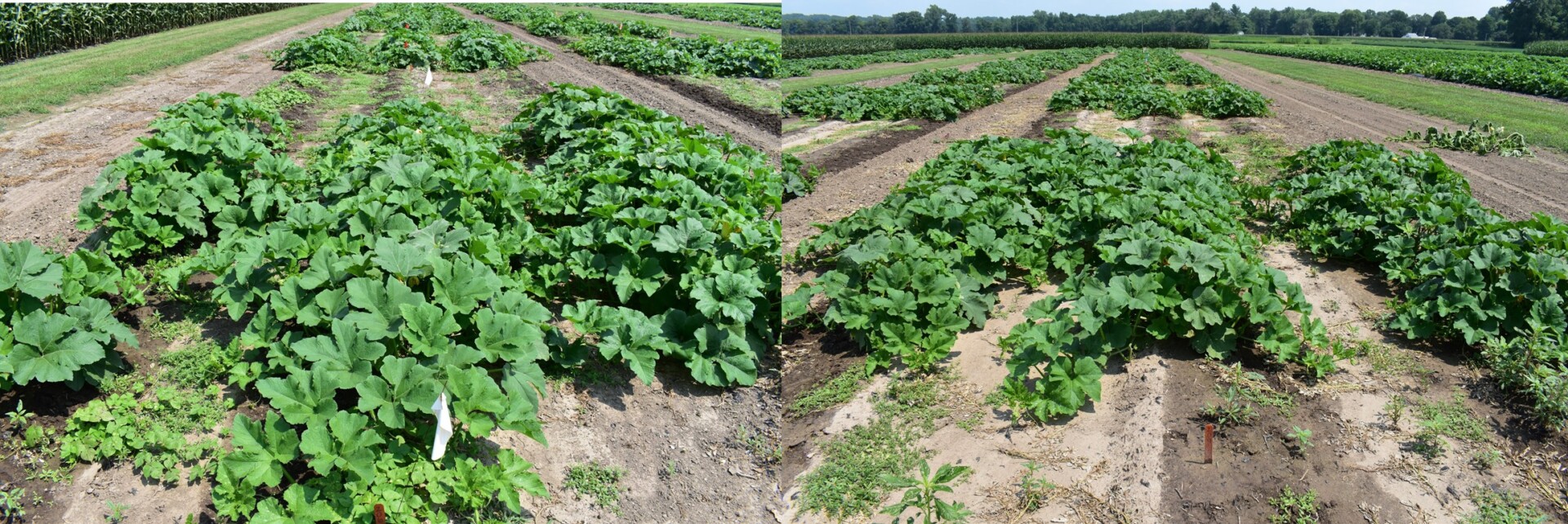
Figure 1. A non-treated control (left) and a plot of ‘Bayhorse Gold’ pumpkins receiving 1.33 pints of Dual Magnum® per acre over-the-top of the crop 14 days after planting at the Southwest Purdue Ag Center, Vincennes, IN, in 2021 (Photos by SL Meyers).
Can I Apply it With Other Herbicides?
The label does not prohibit tank-mixing Dual Magnum® with other herbicides registered for over-the-top use in pumpkins. We have only tested the tank-mixture of Dual Magnum® plus Sandea® and non-ionic surfactant, which resulted in increased crop injury (Figure 2). Likely tank-mix partners include the grass-selective herbicides (clethodim, sethoxydim), but crop tolerance has not been tested for this combination. Use extreme caution and trial a small area before adopting untested tank-mixtures on your farm.
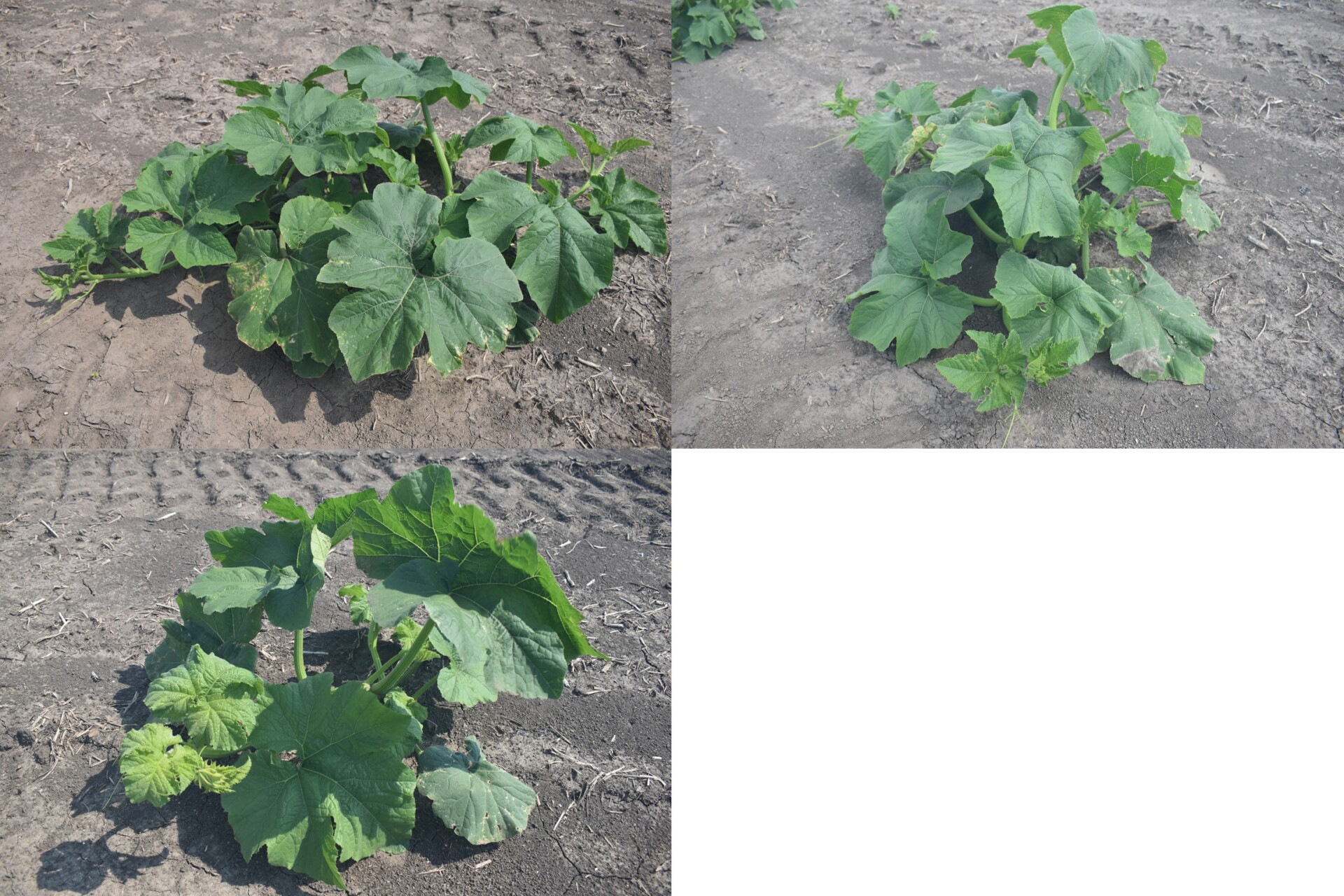
Figure 2. Pumpkin plants from a non-treated control (top left), Dual Magnum® at 1.33 pt/a (top right), and Dual Magnum® at 1.33 pt/a plus Sandea® at 0.5 oz/a (bottom left). Herbicides were applied 28 days after planting at the Meigs Horticulture Research Farm in Lafayette, IN. Note the yellow leaves from the inclusion of Sandea® (Photos by SL Meyers).
Where Can I Find the Updated Label?
This and other Special Local Need pesticide registrations can be found on the OISC website.
Is This Use Labeled in Other States?
This use of Dual Magnum® is expected to only appear on individual state 24C Special Local Need labels, which makes it difficult to keep tabs on which states allow this new use. Many states use the National Pesticide Information Retrieval System, which will allow pesticide applicators to search for labels specific to their state.