Root-knot nematodes (RKN, Meloidogyne spp.) are among the most damaging plant-parasitic nematodes in vegetable production systems. Infective juveniles hatch from eggs in the soil, find and penetrate host plant roots. They migrate to the vascular tissue, where they establish specialized feeding sites, develop into adults, and reproduce by laying eggs on the surface of roots. As feeding sites form, surrounding root cells enlarge and develop into galls, a characteristic symptom of RKN infestation (Figure 1). Root-knot nematodes have a wide host range, and the gall size varies depending on the host crop, nematode species, and severity of infection. For example, tomato plants often develop large, conspicuous galls (Figure 1), whereas pepper plants typically produce smaller, less noticeable galls that can be easily overlooked. Root damage caused by RKN interferes with water and nutrient uptake. Aboveground symptoms commonly include stunted growth, reduced vigor, and nutrient deficiency-like symptoms, ultimately leading to crop yield losses.
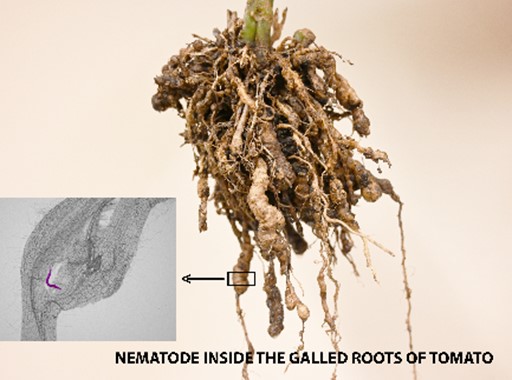
Figure 1. Root-knot nematode damage on tomato roots (Photo by: Lei Zhang).
Over 100 species of RKN have been identified worldwide. Their distributions vary due to their adaptation to various temperatures, environmental conditions, and host plants. The Purdue Nematology Lab conducted RKN species identification on 21 root samples collected across Indiana in the past three years. Those samples include watermelons and cantaloupes grown in open-field sandy soils in southern Indiana, as well as tomato and carrot samples from high tunnels statewide. Based on results to date, three RKN species were identified: M. incognita (84%), M. hapla (14%), and M. arenaria (5%). M. incognita has been detected in all watermelon and cantaloupe samples from southern Indiana and in several tomato samples across the state. M. hapla has been identified in carrot and tomato samples, while M. arenaria was detected in a tomato sample.
The M. incognita (southern root-knot nematode) and M. arenaria (peanut root-knot nematode) are typically found in tropical and subtropical regions, as these species have limited survival at soil temperatures below 50 °F. However, in Indiana, the use of high tunnels, which elevate soil temperatures during winter, and intensive vegetable production in sandy soils, which facilitates nematode movement into deeper, more insulated soil layers, can support the survival and reproduction of these RKN species. In contrast, M. hapla (northern root-knot nematode) is adapted to cooler conditions, can survive soil temperatures below 50 °F, and is commonly found in temperate regions.
Why is it important to know RKN species and virulence?
Identification of RKN species is critical when host resistance is used as a management strategy, particularly in tomato production. Most commercial tomato cultivars and rootstocks with RKN resistance rely on a single dominant gene, Mi-1, which provides resistance to three species: M. incognita, M. arenaria, and M. javanica. However, this gene does not confer resistance to M. hapla. As a result, when M. hapla is the predominant species in a field, resistant cultivars or grafted tomatoes with resistant rootstocks are unlikely to provide effective control.
Another important finding from the Purdue Nematology Lab is the emergence of virulent M. incognita populations capable of overcoming Mi-1-mediated resistance in tomatoes. Between 2021 and 2025, we observed significant root galling on grafted tomato plants with resistant rootstocks at three independent farms in Indiana. In all cases, the nematode species was identified as M. incognita. While resistance breakdown was initially attributed to elevated soil temperatures because Mi-1 resistance can be compromised at soil temperatures above 82 °F, subsequent testing demonstrated that the nematode populations isolated from these plants were able to reproduce on Mi-1 resistant tomato cultivars under controlled conditions at 75 °F. This confirmed the presence of virulent M. incognita populations. Following this discovery, we evaluated 13 commercial tomato rootstocks under infestation by both avirulent and virulent M. incognita populations. All rootstocks effectively suppressed the avirulent populations; however, none provided complete control of the virulent populations.
These findings highlight the importance of identifying RKN species and the virulence within populations. The Purdue Nematology Lab can assist with species and virulence identification. Please contact us if you observe root galling on vegetable crops.
This research is supported by USDA National Institute of Food and Agriculture (Specialty Crop Research Initiative grant number 2021-51181-35904 and Organic Transitions Program grant number 2024-51106-43054) and by the North Central Sustainable Agriculture Research and Education (SARE) (project number LNC24-511).