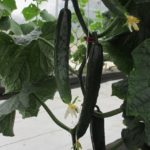
Cucumbers are produced with very different production systems. The ideal cucumber variety for process pickling production is not the variety used for greenhouse production. Choosing the suitable variety for a specific production system then becomes important. Where do you find recommended cucumber varieties for high tunnel production in seed catalogs? Some of the seed catalogs have a category called Greenhouse…Read more about What You Need to Know about Cucumber Varieties for High Tunnel Production[Read More]
Cucurbits
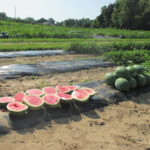
Seedless watermelon variety trials have been conducted at the Southwest Purdue Agricultural Center in Vincennes, IN for more than 20 years. In 2017, we evaluated the performance of 37 standard size seedless watermelon varieties and 4 mini watermelon varieties. This article introduces the top performing varieties in our trial in 2017. Standard size seedless watermelons…Read more about Top Performing Watermelon Varieties in the 2017 Indiana Watermelon Variety Trial[Read More]
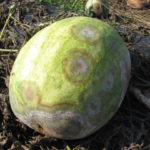
This disease was a serious problem in much of the state this past summer. As a result, I have had many questions about managing this disease. The questions I have been asked have ranged from what do I spray to how does this disease work? Therefore, I have written an article about the symptoms, biology and management…Read more about Phytophthora Blight of Cucurbits[Read More]
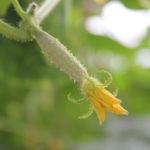
Consumers love cucumbers that are sweet, seedless and have thin skins. They are willing to pay high prices for the long or mini cucumbers sold at grocery stores. These cucumbers are often grown in greenhouses and shipped long distances. It will attract consumers’ attention if greenhouse type cucumbers can be produced locally in high tunnels,…Read more about Are You Interested in Growing Greenhouse Type Cucumbers in High Tunnels, and Targeting for Early Season Production?[Read More]
In the past season, we tested performances of eight specialty melons grown under high tunnel, greenhouse, hydroponic, and conventional field systems. The melon varieties we have tested in our trials include Lilliput, Inspire, Sugar Cube, French Orange, Tasty Bites, Escorial, Savor, and Artemis. Many of these melon varieties are Charentais (Cucumis melo var. cantalupensis). A…Read more about Results of Specialty Melon Variety Trials will be Presented at the Indiana Hort Congress[Read More]
Earlier in August, downy mildew was reported on all cucurbit species in LaPorte County in northwest Indiana and on pumpkins in Starke County (just south of La Porte County). More recently, downy mildew was reported on cucumbers and butternut squash in Knox County in southwestern Indiana. In addition, downy mildew is strongly suspected on cucumbers…Read more about Downy Mildew of Cucurbits[Read More]
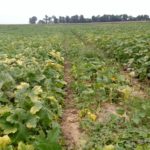
This time of year, I receive many complaints of pumpkin plants with yellow leaves. There can be many reasons why pumpkin plants have yellow leaves. The most common reason for yellow pumpkin leaves doesn’t have anything to do with a disease that can spread from plant to plant. Usually, the reason for the yellow pumpkin…Read more about Yellow Leaves on Pumpkins[Read More]
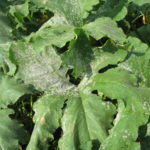
Powdery mildew is a common disease of cantaloupe and pumpkin in Indiana. Occasionally, I observe this disease on watermelon as well. Recently, I have noticed more powdery mildew than usual on watermelon. If left uncontrolled, this disease can cause loss of foliage, loss of yield and lower quality fruit. This article will discuss the biology…Read more about Powdery Mildew of Cucurbits[Read More]

One of the most common diseases of pumpkin in Indiana is powdery mildew. Growers are naturally anxious to observe whether the fungicide they have been applying for this disease has been effective. Therefore, many pumpkin growers scout their fields for disease. Although powdery mildew is relatively easy to recognize, it is possible to become confused. …Read more about Powdery Mildew Symptoms vs Variegated Leaves[Read More]
Read more about Powdery Mildew Symptoms vs Variegated LeavesAfter harvest, storing vegetables in optimal conditions is important to ensure the whole season’s hard work has paid off. This article discusses the optimum storage conditions for tomato, pepper, cucumber, watermelon, cantaloupe and sweet corn. Tomato Ideal storage conditions for tomatoes depend on the maturity stage of picking. If tomatoes are picked at mature green,…Read more about Optimal Storage Conditions for Vegetables[Read More]