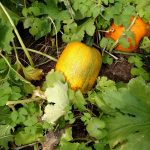
Several pumpkin growers have asked me when to stop managing for pumpkin diseases. That is, when should a pumpkin grower stop applying fungicides? I cannot provide a definitive answer for this question; every grower will have to make his or her own decision. Below, however, are some factors to consider. Estimate the crop yield – walk through the…Read more about Late Season Pumpkin Disease Management[Read More]
Cucurbits
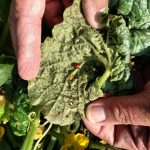
Over the past several weeks, there have been a number of reports of high populations of aphids on cucurbits, as well as report of disappointing levels of control with various insecticides. Without getting into the specifics of individual complaints, here are some suggestions for improved control of aphids. Remember that our primary method of control…Read more about Aphids on Cucurbits[Read More]
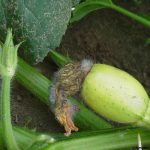
There has been some concern about poor fruit set in pumpkin fields that otherwise have healthy vigorous vines. This summer we have experienced above normal temperatures for much of the pumpkin fruit set season and I suspect that has played a role. This article will consider temperature as well as other factors that influence pumpkin…Read more about Pumpkin Fruit Set[Read More]
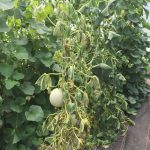
In issue 619 of the Vegetable Crops Hotline newsletter I reported that during April 2016 research focusing on the development of a unique market segment for Indiana melon growers was initiated. The research aims to demonstrate that through the use of high tunnels or greenhouses growers will be able to market melons earlier and increase…Read more about High Tunnel Evaluation of Vertically-Grown Cantaloupe and Galia Melon Varieties[Read More]
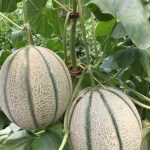
Indiana is a very important player in the domestic melon market. The total acreage planted in Indiana peaked in 1997 at 3,600 acres. In that year the total production was 455,000 cwt with an average income of $16.00 per cwt. The total farm value of production was $7,280,000 ($2,022 per acre). Yield has increased since…Read more about High Tunnel Evaluation of Vertically-Grown Cantaloupe and Galia Melon Varieties and the Development of Best Production Practices for Indiana[Read More]
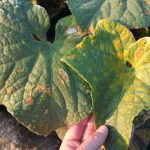
Cucurbit downy mildew has been observed on cucumber and cantaloupe near Wanatah, in La Porte County, Indiana. Downy mildew has also been confirmed on cucumber in St. Joseph County Michigan, just northeast of Elkhart, Indiana as well as on processing pumpkin in central Illinois. Downy mildew of cucurbits has also been reported in southern and…Read more about Cucurbit Downy Mildew Found in Indiana[Read More]
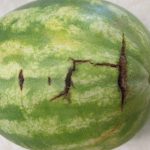
Cross stitch of watermelons is a physiological disorder (not caused by an infectious disease) first reported in 1990s on watermelon fruit. It received the name because the symptom looks like cross stitch. One or more rows of oval-shaped lesions lie along with the longitudinal axis of the fruit. These lesions are normally more close to…Read more about Cross Stitch of Watermelons[Read More]
For many vegetable growers, the season is in full swing. All that hard work in season preparation, planting and maintenance is paying off with harvest. One of the on-going season maintenance issues is applying fungicides. In other articles, I have described how and when to spray. In this article, I want to address when to stop. To limit the scope…Read more about When to Stop Spraying Fungicide[Read More]
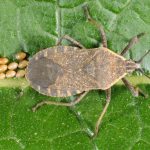
Squash bug is the most consistent insect pest of squash and pumpkins and is the most difficult to control. The key to management is early detection and control of the nymphs. The adults are extremely difficult to kill (Figure 1). Foliar insecticides should be applied to control the nymphs (Figure 2) when you have more…Read more about Squash Bugs[Read More]
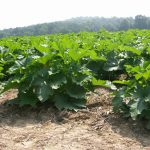
I have received several calls about pumpkins recently. This article will outline a few steps growers should think about to prevent diseases in pumpkins. Virus diseases – There are several virus diseases that affect pumpkins in the Midwest. The most important diseases include: papaya ring spot, watermelon mosaic and zucchini yellow mosaic virus. Aphids transmit all these…Read more about Pumpkin Disease Management Steps[Read More]