Populations of striped cucumber beetles continue to remain high. Muskmelon and cucumber growers should continue to monitor and spray as needed to avoid transmission of the pathogen that causes bacterial wilt of cucurbits. Wilt symptoms are showing up on melons throughout the state at this time, with greater prevalence in the southern counties and less…Read more about Striped Cucumber Beetle[Read More]
Cucurbits
Growers may be wondering whether to replant pumpkin fields where the stand is uneven due to excess moisture. Potential yield of the replants is one thing it would be good to know. We have data on yield of pumpkins direct-seeded or transplanted in mid-July in northern Indiana. The trials were no-till planted into a harvested…Read more about Replanting Poor Stands of Pumpkins[Read More]
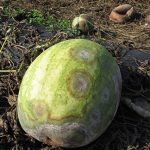
Most growers first notice this disease when large, soft areas develop on mature watermelon fruit. These lesions can be several inches across and are often covered with a white mold. The lesions usually form first on the bottom of the fruit, close to where the fruit comes into contact with the soil. Further development of the…Read more about Phytophthora Fruit Rot of Watermelon[Read More]
A field day will be held on July 9 to share with the public the various research activities at the Southwest Purdue Agricultural Center in Vincennes, IN. The day will start at 7:30 A.M. with a health fair. Registration starts at 8:30 A.M. Presentation topics include: managing cucumber beetles while protecting bees, production of vegetables…Read more about Southwest Purdue Agricultural Center Field Day[Read More]
So far it appears that populations of striped cucumber beetles appear to be low to moderate in most areas. The often cool and/or wet weather may be suppressing their activity currently, so be prepared if we get a period of warm, dry weather. Remember that cantaloupes and cucumbers are most susceptible to bacterial wilt, so…Read more about Striped Cucumber Beetles[Read More]
Striped cucumber beetles are emerging from their overwintering habitat in southern Indiana. This pest can damage cucurbit crops in several ways. One that I saw this week is that they can kill young transplants by their direct feeding. Of more critical concern usually is their ability to transmit the bacterium that causes bacterial wilt of…Read more about Striped Cucumber Beetles[Read More]
It’s early in the growing season, but I am already receiving calls about aphids on melons. We had lots of problems with aphids in 2013 and not very many last year. Particularly at this time of year, I’m recommending Assail® for aphid control on melons for several reasons. First, it does an excellent job killing…Read more about Aphids on Melons[Read More]
I have received calls about seedcorn maggots in melons and have seen wireworm damage in my research plots in Vincennes. Seedcorn maggots are usually associated with cool weather since the adult flies will not lay their eggs near melons plants when the soil temperature exceeds 70°F. So the cool weather we have had this past…Read more about Seedcorn Maggots and Wireworms[Read More]
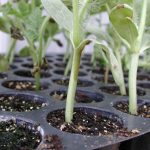
Most watermelon growers are in the process of placing transplants in the field. I have received several commercial samples of transplants still in trays prior to out-planting. The two diseases I have observed so far are gummy stem blight and bacterial fruit blotch. Below, I discuss these two diseases as well as management options. Gummy stem blight on…Read more about Watermelon Disease Update[Read More]
Many cantaloupe and watermelon growers have planted transplants in the field or will soon. A question many growers often have is when and how should one apply fungicides. Applying fungicides according to a weather-based system is easy for cantaloupe and watermelon growers. MELCAST was developed at Purdue University by Rick Latin to allow growers to…Read more about MELCAST[Read More]