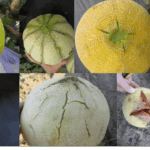
Originally published on: July 25, 2025 Fruit cracking is one of the most commonly observed disorders affecting many fruit crops. Cracking can occur in different forms, such as radial splits extending from the stem end, splits at the blossom end, or concentric rings around the fruit. Research has shown that multiple factors influence fruit cracking….Read more about What Caused the Cracking of Tomatoes and Melons?[Read More]
Cantaloupe
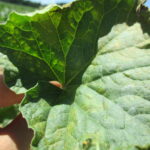
In this article, we discuss another plant nutrient imbalance symptom commonly observed in melon production in southern Indiana: manganese toxicity. Manganese is an essential plant nutrient, but excessive amounts can cause toxic effects. In melons, manganese toxicity usually appears as chlorotic spots made up of many tiny pinhole-like lesions that gradually merge together (Figure 1)….Read more about Melon Nutrient Imbalance – Manganese Toxicity[Read More]
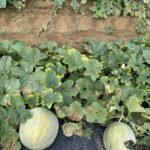
In the next two articles, we discuss two nutrient imbalances in melons commonly observed in southern Indiana: potassium deficiency and manganese toxicity. We will describe the symptoms, field observations, potential factors contributing to their occurrence, and potential remedies. Potassium Deficiency A typical symptom of potassium deficiency in melons is yellowing along the margins of older…Read more about Melon Nutrient Imbalances – Potassium Deficiency[Read More]

In 2023, BASF registered Rely® 280 for use in cantaloupe, cucumber, summer squash, watermelon, tomato, and pepper. The registration occurred as two separate supplemental labels- one for cucurbits and one for fruiting vegetables. Both supplemental labels were set to expire in December of 2025. These supplemental labels allowed for the use of Rely® 280 as…Read more about Rely® 280 Herbicide – Going, Going, Gone[Read More]

The Southern Indiana Melon and Vegetable Growers Meeting is scheduled on Jan. 16, 2026, at French Lick Resort (French Lick Resort & Casino, 8670 IN-56, French Lick, IN 47432). The meeting agenda can be accessed here. The meeting registration fee is $30, including lunch. Registration fee will be collected on-site by the Indiana Vegetable Growers…Read more about 2026 Southern Indiana Melon and Vegetable Growers Meeting[Read More]
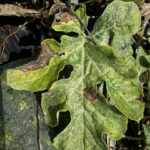
Multiple foliar pathogens (some of which are also major problems for fruits) are appearing in watermelon and cantaloupe crops. It is time to continue or begin fungicide applications to prevent diseases such as gummy stem blight (Figure 1), anthracnose (Figure 2), and Phytophthora blight. During recent field visits, I have observed gummy stem blight and…Read more about Disease Watch: Gummy Stem Blight, Anthracnose, and Phytophthora in Cucurbits[Read More]

Southern Indiana Vegetable Growers Annual Meeting will be held in conjunction with Illiana Watermelon Association Convention (IWA). The meeting will take place on January 17th in French Lick, Indiana. The meeting agenda is posted below. Additional details about the event can be found on the IWA website. Registration and booth questions should be directed to…Read more about Southern Indiana Vegetable Growers & Illiana Watermelon Accociation Winter Meeting[Read More]
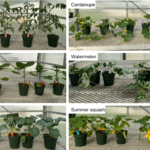
This week, several regions of Indiana experienced excessive rainfall due to the remnants of Hurricane Beryl passing through the state. The heavy rain caused flooding in some vegetable fields. When soil water levels surpass optimal requirements, oxygen is depleted, leading to waterlogging stress for the plants. Figure 1 displays the varied responses of different crops…Read more about Vegetable Responses to Waterlogging Stress[Read More]

By now, most watermelons have been planted in southern Indiana, and most fields are currently in the vegetative growth stage. The earliest planted fields have begun to set fruit. In the past two weeks, I have observed herbicide damage in a few watermelon fields. Although the application rate and method were consistent with the labels…Read more about Watermelon Update[Read More]
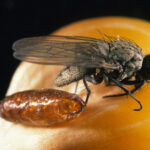
The seedcorn maggot, Delia platura, is one of the first pests that will cause damage to vegetables in the spring in our region. This fly, which resembles a house fly but is smaller (Figure 1), begins to emerge from the overwintering pupal stage in the soil in early spring. Upon emergence, the flies quickly aggregate…Read more about Insect Spotlight: Seedcorn Maggot[Read More]