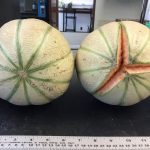
In issue 619 and 620 of the Vegetable Crops Hotline newsletter I gave you a brief background of the materials used and methods followed during the variety evaluation. I also discussed some of the challenges we encountered while doing the trial work. The varieties evaluated included: Entry # Variety 1 Sephia (Galia type) 2 Tirreno…Read more about High Tunnel Evaluation of Vertically-Grown Cantaloupe and Galia Melon Varieties[Read More]
Cantaloupe
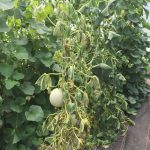
In issue 619 of the Vegetable Crops Hotline newsletter I reported that during April 2016 research focusing on the development of a unique market segment for Indiana melon growers was initiated. The research aims to demonstrate that through the use of high tunnels or greenhouses growers will be able to market melons earlier and increase…Read more about High Tunnel Evaluation of Vertically-Grown Cantaloupe and Galia Melon Varieties[Read More]
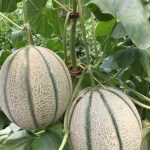
Indiana is a very important player in the domestic melon market. The total acreage planted in Indiana peaked in 1997 at 3,600 acres. In that year the total production was 455,000 cwt with an average income of $16.00 per cwt. The total farm value of production was $7,280,000 ($2,022 per acre). Yield has increased since…Read more about High Tunnel Evaluation of Vertically-Grown Cantaloupe and Galia Melon Varieties and the Development of Best Production Practices for Indiana[Read More]
For many vegetable growers, the season is in full swing. All that hard work in season preparation, planting and maintenance is paying off with harvest. One of the on-going season maintenance issues is applying fungicides. In other articles, I have described how and when to spray. In this article, I want to address when to stop. To limit the scope…Read more about When to Stop Spraying Fungicide[Read More]
The cool, wet weather we are experiencing is perfect for the root and seed maggots, namely cabbage maggot, onion maggot, and seedcorn maggot. One way of avoiding damage from these pests is to wait until the soils warm up to 70o F before planting, but that is not always possible. The use of row covers…Read more about Root and Seed Maggots[Read More]
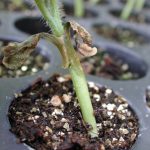
Gummy Stem Blight – this fungal disease causes dark brown leaf spots, however, the diagnostic feature of this disease is the water soaked lesion that is often formed under one of the seed leaves (cotyledons). Such lesions often start at the point where the seed leaf joins the stem (hypocotyl) and do not extend to…Read more about Cucurbit Transplant Diseases[Read More]
Every year since 1980, we have conducted watermelon and cantaloupe variety trials at Southwest Purdue Agricultural Center. In 2016, our variety trials include 44 standard seedless watermelons, 12 cantaloupes, 4 mini-sized seedless watermelons, and 5 seeded watermelon varieties. Seeds have already been planted in the greenhouses and our target date for transplanting in the field…Read more about 2016 Watermelon and Cantaloupe Variety Trials at Southwest Purdue Agricultural Center[Read More]
I have never had as many questions about how to use MELCAST as I did in 2015. The interest in this program is growing both here in Indiana and nationally. Read on to find out how to apply fungicides according to the weather and perhaps save money in the process. MELCAST (MELon disease foreCASTer) is…Read more about MELCAST 2016[Read More]
Downy mildew has been confirmed on jack-o-lantern pumpkins in Daviess and Jasper Counties and on acorn squash in LaPorte County. These are the first confirmed reports of this disease on Cucurbita pepo in Indiana in the 2015 season. There are unconfirmed (but reliable) reports of downy mildew on pumpkins in Parke, Washington, and White Counties. This disease has…Read more about Downy Mildew of Cucurbit Update[Read More]
On July 22, I announced that downy mildew had been observed on watermelon in Knox County in southwestern Indiana. This article in the Vegetable Crop Hotline issue 603, https://ag.purdue.edu/hla/Extension/VegCropsHotline/Pages/Latest-Articles.aspx?article=118, describes the outbreak and management options. Downy mildew has now been reported on cucumber and cantaloupe in Knox and cucumber in La Porte County Indiana and pumpkin in Jasper County….Read more about Downy Mildew Update[Read More]