One of the most damaging pests in cucurbit production are cucumber beetles and the bacterial pathogen they transmit (Erwinia trachephila), leading to bacterial wilt. In the recently released video, Dr. Laura Ingwell from Purdue Entomology demonstrates how to install insect exclusion screens on high tunnels. Such screens are effective at excluding cucumber beetles and the pathogen…Read more about Video—Installing High Tunnel Insect Exclusion Screen[Read More]
Cucurbits
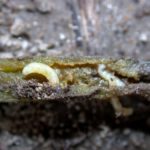
I received my first report of seedcorn maggot damage on cantaloupes last week (Figure 1 and 2). A grower in northern Indiana reported losing 90-95% of his plants. Given the cool, wet growing conditions, it wouldn’t be surprising to see more reports of this type for a number of crops, including melons, beans, corn, onions,…Read more about Seed and Root Maggots[Read More]
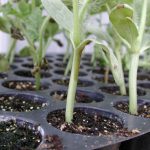
Many cantaloupe and watermelon growers are either growing transplants in a greenhouse or are expecting delivery of transplants in the next few weeks. Either way, growers should inspect transplants for disease before planting in the field. Below I will describe several common transplant diseases of cantaloupe and watermelon as well as management options. Gummy stem…Read more about Cantaloupe and Watermelon Transplant Diseases[Read More]
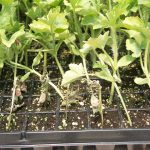
Fusarium wilt is one of the most serious diseases of watermelon in the Midwest. The disease often causes a one-sided wilt 2-3 weeks after transplanting. Whether a plant is affected, and to what degree, depends on the population of the long-lived spores in the soil that the roots contact. However, Fusarium wilt of watermelon is…Read more about Evidence for Spread of Fusarium Wilt of Watermelon in Transplant Trays[Read More]
As part of a multi-state effort being headed by Dr. Ian Kaplan at Purdue University in the Department of Entomology, we are investigating how to best manage insect pests on cucurbits, in our case watermelons, while having the least possible impact on pollinators. The research is being funded through the USDA/NIFA Specialty Crop Research Initiative….Read more about Purdue Looking for Watermelon Growers to Collaborate on Research Study[Read More]
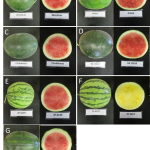
— Notes from Watermelon Research and Development Group Annual Meeting and 2016 Indiana Watermelon Variety Trial We are proud to be in Vincennes, the heart of watermelon producing counties in Indiana. In case you are unfamiliar with watermelon production here, Indiana is just behind Florida, Texas, Georgia, California and South Carolina in watermelon production nationwide….Read more about Watermelon Variety Considerations[Read More]
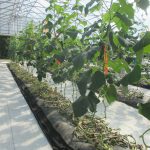
Tomato is considered one of the most profitable crops grown in high tunnels, but continually growing one single crop leads to build-up of diseases. In addition, growers are facing more competition in selling tomatoes in the market. To enhance resilience of high tunnel system and increase access to consumers, crop diversification is important. In this article, instead…Read more about 2016 Cucumber Variety Evaluation in a High Tunnel at Southwest Indiana[Read More]
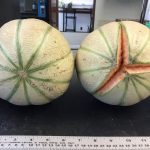
In issue 619 and 620 of the Vegetable Crops Hotline newsletter I gave you a brief background of the materials used and methods followed during the variety evaluation. I also discussed some of the challenges we encountered while doing the trial work. The varieties evaluated included: Entry # Variety 1 Sephia (Galia type) 2 Tirreno…Read more about High Tunnel Evaluation of Vertically-Grown Cantaloupe and Galia Melon Varieties[Read More]
With the start of pumpkin harvest, it is a good time to review important considerations for harvest and postharvest storage of pumpkins and winter squash (butternut, acorn and hubbard squash etc.). First, pumpkin and winter squash should be harvested fully mature to reach their optimal quality and fulfill their potential for long shelf lives. Characters…Read more about Harvest and Postharvest Storage of Pumpkins and Winter Squash[Read More]
Downy mildew has now been observed on butternut squash, jack-o-lantern pumpkins and cucumbers in Knox County. The list of cucurbits observed in Porter County has been updated to include butternut squash and giant pumpkin. All cucurbit growers should assume that downy mildew is present nearby and may attack any cucurbit crop. However, it is not clear what affect…Read more about Downy Mildew of Cucurbit Update[Read More]