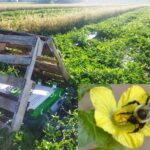
Seedless watermelons are extremely dependent on pollinators for yield. A pollinator, typically a bee, has to first visit a male flower from a pollinizer plant (pollen donor) and then deposit the pollen on a female flower from the seedless plant. That pollinated female flower will become a seedless watermelon fruit. This pollen-transfer job can be…Read more about Do Managed Bumble Bees Contribute to Seedless Watermelon Pollination?[Read More]
Ian Kaplan

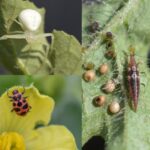
Growing watermelons in Indiana isn’t always easy if you have cucumber beetles and spider mites. These pests are some of the most damaging to Midwest cucurbits and are commonly managed with a combination of insecticides and miticides. Unfortunately, chemical management for one pest could interfere with control of another pest. For example, spider mite outbreaks…Read more about Want Fewer Spider Mites? Ease Up on the Beetle Spraying![Read More]
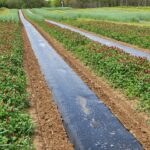
In watermelon systems in Indiana, cover crops are extensively used with the primary function of acting as a wind-break to protect the seedlings when they are planted in May. Due to the nature of the landscape and the soil type (e.g., open areas with sandy soils), seedlings are exposed to physical damage caused by sandblasting….Read more about Enhancing Insect Pest and Pollinator Management with Flowering Cover Crops[Read More]
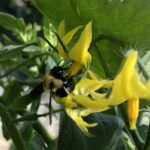
The importance of bees for providing pollination is a regularly discussed topic in many fruit and vegetable production systems. Although tomatoes are often pollinated by wind, they too can benefit from bee pollination. Recent research suggests that tomato flowers visited by bees have a larger fruit set and produce heavier fruits. An ongoing study in…Read more about Pollination Services in Tomatoes[Read More]
Crop rotation is a standard part of vegetable crop production. At its core, crop rotation is a management tactic meant to disrupt pest lifecycles and decrease the incidence of economically damaging infestations of insects and pathogens. However, surprisingly little scientific research appears to have explored which rotations are most effective for breaking pest lifecycles and…Read more about We Need Your Feedback on Veggie Rotations and Field Layouts[Read More]