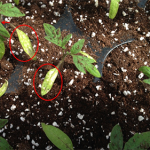
This is the time of year when growers often call to complain about tomato transplants that do not look right. One possibility is that the seedlings suffer from heater problems. In particular, tomato plants are very susceptible to damage from the gas ethylene. In Figure 1, some of the seedlings have leaves that are curled down and stems that are twisted (epinasty in…Read more about Ethylene Damage on Tomato[Read More]
Solanaceous Crops

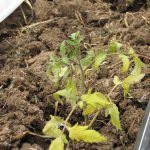
Sometimes newly transplanted crops don’t take off like we’d expect. Consider the newly transplanted tomato seedlings in these images. In Figure 1, lower leaves are chlorotic (yellow) and leaflet edges and leaves curl downward. In Figure 2, lower leaves are chlorotic or bleached and some had necrotic (dead) spots. In Figure 3, some leaves have…Read more about Too Much Fertilizer for Transplants?[Read More]
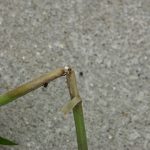
In early March, I observed white mold of recently transplanted tomato plants in a greenhouse situation. I have described the symptoms, biology and management of white mold at https://ag.purdue.edu/arp/swpap/VeggieDiseasesBlog/Lists/Posts/Post.aspx?ID=18 . I have never observed white mold (a.k.a, timber rot) in February before. I have observed white mold of tomato transplants in April. However, the very…Read more about White Mold of Tomatoes Observed in Greenhouse[Read More]
One way insects communicate with individuals of the same species is with pheromones. Pheromones are volatile chemicals released by an insect that usually can be detected only by individuals of the same species. There are a number of different types of pheromones, but the most common type is the sex pheromone. Usually the females will…Read more about Pheromones and Pheromone Traps[Read More]
Bacterial spot of tomato is one of the most serious diseases facing tomato growers in Indiana. As described at Vegetable Diseases in Greenhouses (PDF), bacterial spot is more of a problem for field tomatoes than for greenhouse tomatoes. Symptoms and management of bacterial spot are described briefly at Bacterial Spot of Tomato and Pepper (PDF). A more detailed…Read more about An Update on the Use of Copper Products for Managing Bacterial Spot of Tomato[Read More]
Over the last several years, the number of questions I have had about tomato production in high tunnels has increased dramatically. Since I am a plant pathologist, most of the questions I have been asked are about diseases of tomatoes in high tunnels. However, I also have been asked production questions. One particular question about…Read more about How Many Staked Tomatoes Should I Put in My High Tunnel?[Read More]
Read more about How Many Staked Tomatoes Should I Put in My High Tunnel?While visiting my son in Lincoln, Nebraska this past summer, I had the chance to browse in a second hand store.I felt myself drawn to the book section where I found a green hard cover book titled, “Yearbook of Agriculture, 1928”. From 1894 until 1992, the Department of Agriculture published a Yearbook of Agriculture annually….Read more about Indiana’s Processing Tomato Industry in 1928 and 2013.[Read More]
Read more about Indiana’s Processing Tomato Industry in 1928 and 2013.For 100 years bacterial spot has been causing huge losses for tomato growers worldwide. For 100 years products containing copper have held the key to controlling this devastating tomato disease. As tomato growers enter their second century of dealing with bacterial spot, the question has become whether copper applications lessen the severity of bacterial spot-or…Read more about An Update on the Use of Copper Products for Managing Bacterial Spot of Tomato[Read More]
Read more about An Update on the Use of Copper Products for Managing Bacterial Spot of Tomato
The photos that accompany this article are of lesions caused by various diseases that occur on tomato fruit. The list includes diseases I commonly see in Indiana, so the list is not all inclusive. More information can be found on the Purdue Tomato Doctor app. I welcome any comments or questions. Bacterial spot of tomato….Read more about Tomato Fruit Lesions[Read More]
Read more about Tomato Fruit Lesions