
A new video explaining how to graft tomatoes is available at https://youtu.be/7Ufx66Isf88
Solanaceous Crops
Effectively managing foliar diseases including late blight (LB), early blight (EB), and Septoria leaf spot (SLS), is one of the biggest challenges facing organic tomato growers. New, resistant hybrid varieties are available, but organic growers often plant heirloom varieties instead because they are perceived to have superior flavor and growers can save seed. Copper fungicides…Read more about The TOMI Project Aims to Help Tomato Growers Better Manage Foliar Diseases[Read More]

There are several potential benefits of growing grafted tomatoes, particularly for early season tomato production in greenhouses or high tunnels. If you are interested in trying this technique but wondering whether it is possible to graft tomato plants by yourself, a Purdue extension publication, Techniques for Tomato Grafting, (https://extension.purdue.edu/extmedia/HO/HO-260-W.pdf ) provides a step-by-step guideline for small…Read more about Growing Grafted Tomatoes in High Tunnels[Read More]
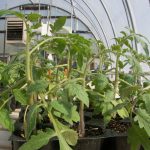
Almost every year, I have a greenhouse tomato grower or two call me about tomato plants that are distorted and don’t seem to be growing right. The problem often turns out to be ethylene damage. This year, I have decided to write an article about it before I get those calls. Tomato plants with ethylene damage…Read more about Ethylene Damage on Tomato Plants[Read More]
For many vegetable growers, the season is in full swing. All that hard work in season preparation, planting and maintenance is paying off with harvest. One of the on-going season maintenance issues is applying fungicides. In other articles, I have described how and when to spray. In this article, I want to address when to stop. To limit the scope…Read more about When to Stop Spraying Fungicide[Read More]
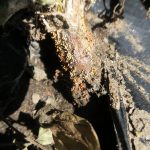
Southern blight of tomato thrives under hot, dry conditions. Usually, such conditions are more common in August than early July. However, 2016 has been relatively hot and dry in southwest Indiana. Perhaps for this reason, I have observed this disease in my own tomato plots. This article will discuss the symptoms, biology and management of southern blight of…Read more about Southern Blight of Tomato[Read More]
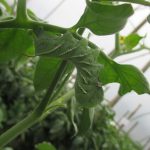
Hornworms can be pests of tomato and pepper in field grown crops, but for some reason seem to be particularly severe in high tunnels. Hornworms are very large caterpillars, measuring up to 4 inches long (Figure 1), and they can consume large quantities of foliage and will also feed on green fruit (Figure 2). In…Read more about Hornworms[Read More]
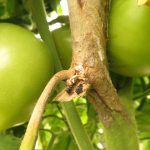
Below, I will briefly discuss four diseases that I have observed on tomatoes recently. White mold of tomato – Perhaps the most common symptom of white mold of tomato is the light brown area on the lower stem (Figure 1). This brown area is essentially dead and will result in the wilt and death of the…Read more about Tomato Disease Update[Read More]
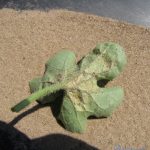
We have received a number of reports of outbreaks of spider mites, primarily in watermelons in the field and cucumbers in high tunnels. Spider mite damage can be recognized by the chlorosis often observed on older leaves (Figure 1). Plus, the underside of leaves affected by spider mites often appears ‘dirty’ due to the debris caught…Read more about Spider Mites[Read More]
Last week, the highest temperature reached 110°F for a few successive days inside of our high tunnels. As a result, we observed some blossom drop on tomatoes. More information on high temperature effects on tomato fruit set can be found here. In addition to blossom drop, high temperature and high light intensity contribute to sunscald injury,…Read more about Whether to Put Shade Cloth on High Tunnel Tomatoes[Read More]