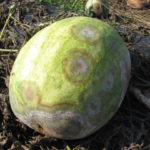
This disease was a serious problem in much of the state this past summer. As a result, I have had many questions about managing this disease. The questions I have been asked have ranged from what do I spray to how does this disease work? Therefore, I have written an article about the symptoms, biology and management…Read more about Phytophthora Blight of Cucurbits[Read More]
Plant Disease Management
Earlier in August, downy mildew was reported on all cucurbit species in LaPorte County in northwest Indiana and on pumpkins in Starke County (just south of La Porte County). More recently, downy mildew was reported on cucumbers and butternut squash in Knox County in southwestern Indiana. In addition, downy mildew is strongly suspected on cucumbers…Read more about Downy Mildew of Cucurbits[Read More]
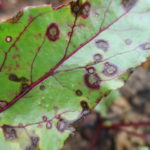
This disease was observed in southern Indiana recently. Cercospora leaf spot affects table beets and swiss chard. Symptoms include circular leaf spots that may have a reddish margin. The center of the lesions may start off a light brown and turn to gray after the fungus (Cercospora beticola) begins to sporulate. Under conditions conducive to…Read more about Cercospora Leaf Spot of Beet[Read More]
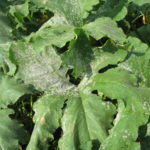
Powdery mildew is a common disease of cantaloupe and pumpkin in Indiana. Occasionally, I observe this disease on watermelon as well. Recently, I have noticed more powdery mildew than usual on watermelon. If left uncontrolled, this disease can cause loss of foliage, loss of yield and lower quality fruit. This article will discuss the biology…Read more about Powdery Mildew of Cucurbits[Read More]

One of the most common diseases of pumpkin in Indiana is powdery mildew. Growers are naturally anxious to observe whether the fungicide they have been applying for this disease has been effective. Therefore, many pumpkin growers scout their fields for disease. Although powdery mildew is relatively easy to recognize, it is possible to become confused. …Read more about Powdery Mildew Symptoms vs Variegated Leaves[Read More]
Read more about Powdery Mildew Symptoms vs Variegated Leaves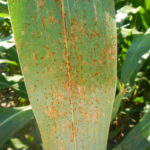
Southern rust of corn is normally a disease of tropical areas. During summer months, however, the fungus which causes southern rust, Puccinia polysora, often moves into southern areas of the U.S. This summer, southern rust has been observed in at least 11 Indiana counties. Symptoms of southern rust include raised structures called pustules. If rubbed…Read more about Southern Rust of Sweet Corn[Read More]
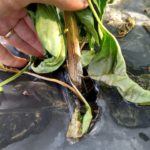
Southern blight of pepper and tomato thrives under hot, dry conditions. Usually, such conditions are more likely in August. Production under tunnels may contribute to the dry conditions that influences southern blight. This article will discuss the symptoms, biology and management of southern blight of tomato. Southern blight has a wide host range affecting many vegetable,…Read more about Southern Blight of Pepper and Tomato[Read More]
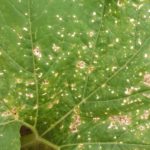
I have observed this disease in scattered commercial pumpkin and squash fields across Indiana. Bacterial leaf spot of pumpkin is perhaps the most serious disease of pumpkin in Indiana today. Symptoms: Bacterial spot causes ⅛-¼ inch angular leaf lesions that are white to light brown in color (Figure 1). These leaf lesions may be accompanied…Read more about Bacterial Spot of Pumpkin[Read More]
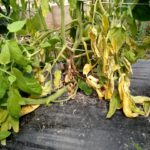
White mold has a large host range including tomatoes (where it may be referred to as timber rot), cucumbers, lettuce and snap beans as well as many more. In this article, I will concentrate on white mold on tomatoes in a greenhouse situation. Although white mold will occur in a field situation, this disease is…Read more about White Mold of Vegetables[Read More]
Cantaloupe, watermelon and pumpkin growers can use information in the Midwest Vegetable Production Guide for Commercial Growers (ID-56) to help determine what fungicides to apply. The MELCAST system (see accompanying article in this issue) can be used to help to decide when fungicides should be applied. I have developed two fungicide schedules that I hope will help…Read more about Cucurbit Fungicide Schedules[Read More]