Found 1716 Articles

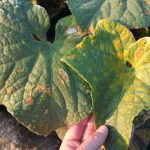
Cucurbit downy mildew has been observed on cucumber in La Porte County and LaGrange Counties, Indiana. Downy mildew of cucurbits has also been reported in southern and central Kentucky. All cucurbit growers in Indiana should be scouting and managing for downy mildew. The organism that causes downy mildew of cucurbits doesn’t overwinter in Indiana. It has…Read more about Cucurbit Downy Mildew[Read More]

Many years ago, I was told that to successfully use fungicides on vegetables, one must use high spray pressures and hollow cone nozzles. However, I had trouble finding any research on this topic, just rumors. So, I did my own research. Dennis Nowaskie, Superintendent at the Southwest Purdue Agricultural Center (SWPAC) built a single row…Read more about Spray Pressure and Nozzle Type[Read More]
Since there is an article about the application of insecticides in this issue, below I list 10 rules that will help vegetable growers apply fungicides effectively and safely. Apply fungicides prior to the development of disease. Although many fungicides have systemic (“kick back”) action they will not completely eradicate diseases after they have started. And…Read more about 10 Useful Rules for Fungicide Applications[Read More]

Daviess Co. Produce Production Meeting Date: Aug. 14, 2018 6:30 pm – 8:30 pm Location: Daviess Co. Produce Auction, LLC, 5567 N 900 E, Montgomery, IN 47558 Small Farm Education Field Day Date: Aug. 30, 2018 Location: Purdue Daniel Turf Center (1340…Read more about Upcoming Events[Read More]
It’s not uncommon for us to get calls from growers who are expressing concern about a particular insecticide product that is not working as well as the growers would like. Often, growers will suggest that Product X is no good or that the target insect has now developed resistance to that particular insecticide. Before we…Read more about Why Your Insecticide May Not Be Working as Well as You Would Like[Read More]


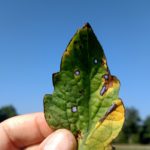
Bacterial spot of tomato has been observed across Indiana this summer. Leaf spots are usually 1/16 inch, and dark. Where lesions are numerous upon a leaf, the tissue may be chlorotic (yellow) (Figure 1 & 2). (In contrast, each lesion of bacterial speck is often accompanied by chlorosis whether lesions are numerous or not.) Lesions…Read more about Bacterial Spot of Tomato[Read More]
Purdue University prohibits discrimination against any member of the University community on the basis of race, religion, color, sex, age, national origin or ancestry, genetic information, marital status, parental status, sexual orientation, gender identity and expression, disability, or status as a veteran. This material may be available in alternative formats. 1-888-EXT-INFO Disclaimer: Reference to products in this publication is not intended to be an endorsement to the exclusion of others which may have similar uses. Any person using products listed in this publication assumes full responsibility for their use in accordance with current directions of the manufacturer.