
Seal the Seasons is a growing food company founded on supporting local growers by making local food available all year-round. Seal the Seasons partners with local family farms on a state-by-state basis to source local food (focused primarily on fruit and vegetables), freeze it, and sell to grocers, with the grower proudly featured on the bag,…Read more about A Food Company Looking for Partner Growers in Indiana[Read More]

Following the success of last year’s Summer Field Tour at Tuttle Orchards, this year we are again planning a combined summer field tour with the Indiana Horticultural Society, the Indiana Vegetable Growers’ Association and the Indiana Farm Market Association. We will be hosted by Garwood Orchards in La Porte, IN. While we encourage membership in…Read more about Summer Field Tour – Fruit and Vegetables[Read More]
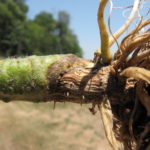
Below, I will briefly discuss a few of the diseases that I have observed on tomatoes recently. Powdery mildew of tomato – Powdery mildew of tomato is not usually a common problem in Indiana. However, in recent years, there have been more reports of this disease than usual. Powdery mildew is more often observed in a…Read more about Tomato Disease Update[Read More]
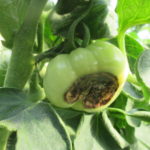
We recently received several calls reporting blossom end rot of tomatoes (Figure 1). Although blossom end rot is caused by deficient supply of calcium to the developing fruit. The occurrence of this physiological disorder often relates to inconsistent supply of water. As a general rule, vegetables require 1-1.5 acre-inches of water per week. Since there…Read more about Are You Applying Enough Water for Vegetables Grown in High Tunnels?[Read More]


Southwest Purdue Ag Center High Tunnel Tour Date: June 13, 2018 7:00-9:00 pm Eastern Time Location: Southwest Purdue Agricultural Center, 4369 North Purdue Road, Vincennes, IN, 47591 The SWPAC high tunnel tour will be held on the evening of June 13, 2018. Seedless cucumber production in high tunnels will be the highlight of this year’s…Read more about Upcoming Events[Read More]
Would you like to learn more about biological control and how to use it successfully? New York State Integrated Pest Management biocontrol specialist Amara Dunn has a new blog – “Biocontrol Bytes” (https://blogs.cornell.edu/biocontrolbytes/). Short articles are posted approximately once a month to share information, answer stakeholder questions, and connect readers to other relevant resources. Subscribe…Read more about A Blog about Biological Control[Read More]
Three videos on in-row weeding tools (Finger weeder, Torsion weeder, Tine harrow) were developed at the Michigan State University Department of Horticulture. Each video is 20 minutes: introduces the tool, how it works, different models, show adjusting the tool in the field, and a short interview with a farmer who uses the tool. These videos can…Read more about Videos on Mechanical Weed Control[Read More]
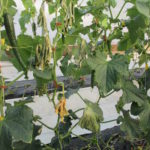
Bacterial wilt is one of the most destructive diseases in high tunnel cucumber production. The reason bacterial wilt is so important is because, like other wilt diseases, it ties up with the entire vascular system of a plant, causing systemic effects (Figure 1). The relatively less important roles that other cucumber diseases play also make…Read more about Bacterial Wilt of Cucumbers Grown in a High Tunnel[Read More]
Purdue University prohibits discrimination against any member of the University community on the basis of race, religion, color, sex, age, national origin or ancestry, genetic information, marital status, parental status, sexual orientation, gender identity and expression, disability, or status as a veteran. This material may be available in alternative formats. 1-888-EXT-INFO Disclaimer: Reference to products in this publication is not intended to be an endorsement to the exclusion of others which may have similar uses. Any person using products listed in this publication assumes full responsibility for their use in accordance with current directions of the manufacturer.