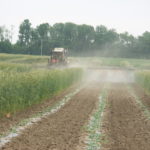
MELCAST is a weather-based disease-forecasting program that helps growers schedule foliar fungicides. MELCAST stands for MELon disease forCASTer. This program, designed by Dr. Rick Latin, Professor of Plant Pathology at Purdue University, keeps track of weather conditions so that cantaloupe and watermelon growers can apply foliar fungicides to their crops when they are most needed….Read more about MELCAST 2018[Read More]
Found 1716 Articles
Entomologists are looking for growers willing to participate in research examining the detection and distribution of striped cucumber beetles. We would like to visit your fields on multiple occasions this year to count the number of cucumber beetles we encounter in your crop. If you grow slicing cucumbers in the field, and are interested in helping to improve…Read more about Entomologists Looking for Cucumber Beetles[Read More]

Southwest Purdue Ag Center High Tunnel Tour Date: June 13, 2018 7:00-9:00 pm Eastern Time Location: Southwest Purdue Agricultural Center, 4369 North Purdue Road, Vincennes, IN, 47591 The SWPAC high tunnel tour will be held on the evening of June 13, 2018. Topics that will be discussed include: Grafting cucumbers for season extension; Seedless cucumber…Read more about Upcoming Events[Read More]

Would you buy something if you didn’t understand how it worked or what to do with it? Likely not… Imagine a customer of yours who doesn’t know how to select, prepare or store the fresh healthful produce that you are growing and offering for sale. How likely is it that they will buy that product? Or buy it twice?…Read more about Use FoodLink to Increase Awareness and Sales of Fresh Produce[Read More]
Nematology lab at Purdue University will be closing at the end of June. The first of June is the last day the lab will accept samples. A list of private and public nematology labs can be found here. Please contact these labs for their requirements for nematode sample submission. Click here to view the listing…Read more about Nematology Lab at Purdue will be Closing[Read More]
Thinking of sending samples of your vegetables to the Plant and Pest Diagnostic Lab for diagnosis or insect ID? Here are some tips to help the samples arrive in the best possible condition for testing. Fill out a sample submission form. Download at: https://ag.purdue.edu/btny/ppdl/Pages/physicalspecimens.aspx If sending more than one kind of plant or problem be…Read more about Tips for Submitting Samples to the Purdue Plant and Pest Diagnostic Lab (PPDL)[Read More]
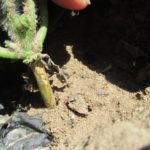
This article provides more detailed information about this herbicide. How does Chateau® herbicide work Chateau® is a group 14 mode-of-action herbicide. Compounds in this group are most active on broadleaf weeds. Before Chateau® became available, no other preemergence herbicide with the same mode of action was labeled for use in watermelons and cantaloupes. The active…Read more about Chateau Herbicide for Use in Melon Production[Read More]
One can hardly glance at the news recently without noticing an item about the health of bees and other pollinators. We can all agree on the importance pollinators play in the health of our planet and the critical role honey bees and bumble bees play in agriculture. There is no doubt that populations of honey…Read more about Pollinator Health and Foliar Fungicide Use[Read More]
Chateau SW® herbicide now has a 24(c) special local needs label for cucurbits. This product is produced by Valent, but the label is held by the Indiana Vegetable Growers Association (IVGA). To obtain a label, one must be a member of the IVGA, pay an annual $100 processing fee, read and understand the ‘conditions for…Read more about Chateau Herbicide SW 24(c) label[Read More]
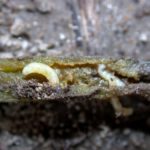
Three species of seed and root maggots attack vegetables in Indiana. The seedcorn maggot feeds on seeds and seedlings of sweet corn, cucurbits, lima and snap beans, peas, and other crops. Cabbage maggots can cause serious damage to transplants of cabbage, broccoli, cauliflower, and Brussels sprouts and make the fleshy roots of radishes, turnips, and…Read more about Seed and Root Maggots[Read More]
Purdue University prohibits discrimination against any member of the University community on the basis of race, religion, color, sex, age, national origin or ancestry, genetic information, marital status, parental status, sexual orientation, gender identity and expression, disability, or status as a veteran. This material may be available in alternative formats. 1-888-EXT-INFO Disclaimer: Reference to products in this publication is not intended to be an endorsement to the exclusion of others which may have similar uses. Any person using products listed in this publication assumes full responsibility for their use in accordance with current directions of the manufacturer.