2015 marks the 40th year of my career as an entomologist and I still am surprised on a regular basis by how insects behave. I put out a corn earworm pheromone trap on May 14 and immediately caught 7 moths that night. Over the next three nights, I caught 36 moths. Typically, the few earworms…Read more about Corn Earworms[Read More]
Tomato
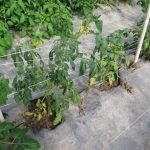
Symptoms of this disease include tomato plants with lower leaves that become yellow (chlorotic) and die; plants that begin to wilt; a lesion on the lower stem at ground level (Figures 1 and 2). If tomato plants are removed from the soil and carefully split open from the ground level, a discoloration of the vascular tissue…Read more about Fusarium Crown and Root Rot of Tomato[Read More]
Last year at the Southwest Purdue Agricultural Center (SWPAC) we conducted a tomato high tunnel trial described here. In this article, I would like to talk about the trial we will conduct in 2015, a repeat of the 2014 trial. In particular, I would like to talk about what we have done for fertility….Read more about Fertility for the Southwest Purdue Agricultural Center Tomato Trial[Read More]
Read more about Fertility for the Southwest Purdue Agricultural Center Tomato Trial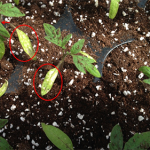
This is the time of year when growers often call to complain about tomato transplants that do not look right. One possibility is that the seedlings suffer from heater problems. In particular, tomato plants are very susceptible to damage from the gas ethylene. In Figure 1, some of the seedlings have leaves that are curled down and stems that are twisted (epinasty in…Read more about Ethylene Damage on Tomato[Read More]

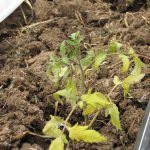
Sometimes newly transplanted crops don’t take off like we’d expect. Consider the newly transplanted tomato seedlings in these images. In Figure 1, lower leaves are chlorotic (yellow) and leaflet edges and leaves curl downward. In Figure 2, lower leaves are chlorotic or bleached and some had necrotic (dead) spots. In Figure 3, some leaves have…Read more about Too Much Fertilizer for Transplants?[Read More]
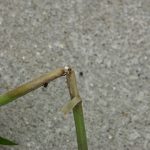
In early March, I observed white mold of recently transplanted tomato plants in a greenhouse situation. I have described the symptoms, biology and management of white mold at https://ag.purdue.edu/arp/swpap/VeggieDiseasesBlog/Lists/Posts/Post.aspx?ID=18 . I have never observed white mold (a.k.a, timber rot) in February before. I have observed white mold of tomato transplants in April. However, the very…Read more about White Mold of Tomatoes Observed in Greenhouse[Read More]
One way insects communicate with individuals of the same species is with pheromones. Pheromones are volatile chemicals released by an insect that usually can be detected only by individuals of the same species. There are a number of different types of pheromones, but the most common type is the sex pheromone. Usually the females will…Read more about Pheromones and Pheromone Traps[Read More]
Bacterial spot of tomato is one of the most serious diseases facing tomato growers in Indiana. As described at Vegetable Diseases in Greenhouses (PDF), bacterial spot is more of a problem for field tomatoes than for greenhouse tomatoes. Symptoms and management of bacterial spot are described briefly at Bacterial Spot of Tomato and Pepper (PDF). A more detailed…Read more about An Update on the Use of Copper Products for Managing Bacterial Spot of Tomato[Read More]
Over the last several years, the number of questions I have had about tomato production in high tunnels has increased dramatically. Since I am a plant pathologist, most of the questions I have been asked are about diseases of tomatoes in high tunnels. However, I also have been asked production questions. One particular question about…Read more about How Many Staked Tomatoes Should I Put in My High Tunnel?[Read More]
Read more about How Many Staked Tomatoes Should I Put in My High Tunnel?