Do you use cover crops in your vegetable operation? Dr. James Farmer, Assistant Professor at Indiana University, is looking for farmers who use cover crops to participate in interviews about the use of cover crops, education/training in using cover crops, and the outcomes of cover crop usage. The interviews will be either in person or…Read more about Participants Needed for Cover Crop Interviews[Read More]
Liz Maynard

Clinical Engagement Assistant Professor of Horticulture
Department of Horticulture and Landscape Architecture
Liz Maynard's website
Department of Horticulture and Landscape Architecture
Liz Maynard's website
Effective Management of Farm Employees – Webinar. Thursday, May 28, 2015. 12:00 p.m. – 1:00 p.m. EDT. Register at http://goo.gl/NvQ1eL. This webinar will be facilitated by Phil Durst and Stan Moore from Michigan State University. These Extension Senior Extension Educators will discuss the impact of personnel management on the engagement of employees based on phone…Read more about Upcoming Events – Managing Employees and GAPs A to Z[Read More]
Some of the herbicides available for use on vegetables in Indiana are registered under a supplemental label or under a special local needs (SLN, 24(c)) registration. In these cases the instructions for use on vegetables are not on the main label that comes with the purchased product. For instance, in the Midwest Vegetable Production Guide,…Read more about Finding a Special Local Needs Pesticide Label Online[Read More]
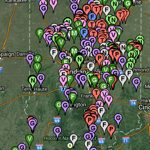
Vegetable, fruit, and organic farmers can register their production areas on Driftwatch.org to let commercial pesticide applicators know where the fields are. Beekeepers can also register sites where beehives are located. Once sites are registered and approved they appear on the Driftwatch registry map (see Fig. 1) and partnering applicators are notified. This helps applicators…Read more about Are Your Fields Listed at Driftwatch.org?[Read More]
Cover crops should be killed at least a couple of weeks before planting vegetables. That will give the cover time to partially decompose, and time for any cutworm larvae that may be in the crop to die or pupate. If wet weather delays killing or incorporation of cover crops, the time between incorporation and planting…Read more about Managing Cover Crops in Spring[Read More]
(Information provided by Office of the Indiana State Chemist, 765-494-1492, www.oisc.purdue.edu) The Indiana Pesticide Clean Sweep Project designed to collect and dispose of suspended, canceled, banned, unusable, opened, unopened or just unwanted pesticides (weed killers, insecticides, rodenticides, fungicides, miticides, etc.) is being sponsored by the Office of Indiana State Chemist (OISC). This disposal service is…Read more about Plan to Dispose of Unwanted Pesticides[Read More]
Purdue Extension is starting the Indiana Food Hub Network this year. So what’s a food hub? The USDA working definition is “a centrally located facility with a business management structure facilitating the aggregation, storage, processing, distribution, and/or marketing of locally/regionally produced food products.” Extension educator Roy Ballard, who is workkng with Local Food Coordinator Jodee…Read more about Indiana Food Hub Email List[Read More]
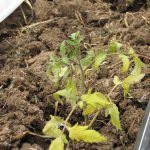
Sometimes newly transplanted crops don’t take off like we’d expect. Consider the newly transplanted tomato seedlings in these images. In Figure 1, lower leaves are chlorotic (yellow) and leaflet edges and leaves curl downward. In Figure 2, lower leaves are chlorotic or bleached and some had necrotic (dead) spots. In Figure 3, some leaves have…Read more about Too Much Fertilizer for Transplants?[Read More]
Two USDA grant programs may be of interest to vegetable growers or grower organizations. The Rural Energy for America Program helps growers and small rural business improve energy efficiency, or purchase or install renewable energy systems. The program includes guaranteed loan financing and grant funding. For more information see the USDA website at www.rd.usda.gov/programs-services/rural-energy-america-program-renewable-energy-systems-energy-efficiency or…Read more about Grant Programs: Rural Energy for America and Specialty Crop Block Grant[Read More]