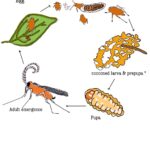
We want to introduce you to a predatory insect that you will find in your cropping systems, and it’s a fly! Predatory gall midges belong to the Cecidomyiidae family and undergo complete metamorphosis from egg through three larval instars, pupa, and finally, the adult stage (Figure 1). This insect overwinters as larvae in cocoons in…Read more about An Introduction to Predatory Gall Midges[Read More]
Laura Ingwell

Entomology
Area(s) of Interest: Vegetable Pest Management, Protected Agriculture, Controlled Environment Agriculture, Urban Agriculture
Area(s) of Interest: Vegetable Pest Management, Protected Agriculture, Controlled Environment Agriculture, Urban Agriculture
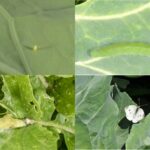
Cabbage white butterflies are medium-sized white butterflies in the family Pieridae. They have black spots on their wings, and a black band on the top of their forewings (top wings), distinguishing them from other species. The butterflies themselves don’t do any damage, however their caterpillars do significant damage to plants in the Brassica family, including…Read more about Insect Spotlight: Cabbage White Butterfly (Pieris rapae)[Read More]
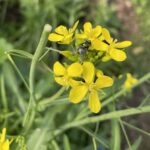
Blow flies are a group of iridescent green or blue flies belonging to the family Calliphoridae. Flies undergo complete metamorphosis, transitioning through egg-larva(maggot)-pupa-adult. Often in this situation, the larvae and adults occur in different environments and feed on different food sources. In fact, blow fly larvae are carrion feeders, meaning they feed on the decaying…Read more about Insect Spotlight: Blow Flies[Read More]
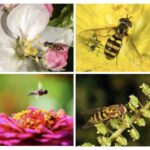
The presence of syrphid flies, also called hoverflies, is a welcome sight in agricultural landscapes. Syrphid flies contribute to pollination, pest suppression, and decomposition. There are four subfamilies of syrphids: Pipizinae, Eristalinae, Microdontinae, and Syrphinae. Larvae from the Eristalinae subfamily act as recyclers, feeding on decaying organic matter. The Pipizinae subfamily includes species whose larvae…Read more about Insect Spotlight: Syrphid Flies[Read More]
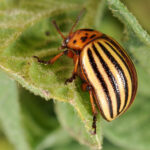
During a recent visit to some potato fields by an Extension Educator in LaGrange County, it was evident that growers need to be on the lookout and take action against some of our major pests in this cropping system. These recent observations revealed cutworms present and impacting every 5th plant in the field, as well…Read more about Potato Pests Abundant in Northern Indiana in late May[Read More]
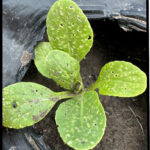
Introduction Flea beetles are small, often metallic, and dark-colored beetles in the family Chrysomelidae. They are given their common name due to their impressive jumping abilities, afforded by their enlarged hind legs, which serve as a near-foolproof escape from predators. Most flea beetle species are oligophagous herbivores, feeding on several related species of plants. For…Read more about Insect Spotlight: Flea Beetles[Read More]
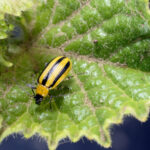
It was timely that in last week’s issue, we chose to spotlight cucumber beetles because they are on the move and hungry. Friday afternoon, I received an email from a grower reporting that his squash transplants were getting hammered (Figure 1). This weekend, I decided to take a look in my own garden, where I…Read more about Cucumber Beetles Are Out In Full Force[Read More]
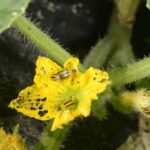
Striped (Acalymma vitattum; StCB) and, to a lesser extent, spotted (Diabrotica undecimpunctata; SpCB) cucumber beetles are damaging pests on crops in the family Cucurbitaceae (e.g., cucumber, squash, pumpkin, watermelon). These pests not only inflict severe damage to various plant parts, including roots, leaves (Figure 1), flowers (Figure 2), and fruits (Figure 3), but transmit the…Read more about Insect Spotlight: Cucumber Beetles[Read More]
What is integrated management? Regardless of the size of a farm, crops grown, or growing practices, integrated pest management (IPM) is a framework that can be used by all growers. The idea of IPM is that you are taking measures at all stages of production and utilizing a variety of tools to minimize the damage…Read more about Integrated Insect Management Strategies for Vegetable Farms[Read More]
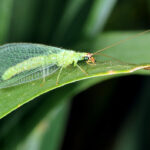
Lacewings are a group of insects commonly found in Indiana and throughout the world. There are several species, but the most common that you will see in Indiana include the green lacewing and the brown lacewing. They belong to a unique order of insects, Neuroptera, and are commonly referred to as aphid lions. The life…Read more about Insect Spotlight: Lacewing (Chrysoperla carnea)[Read More]