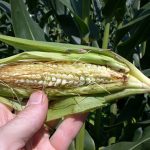
I have seen more green stink bugs this year than at any time in my career. I have no logical explanation for their abundance. It was thought that as the invasive brown marmorated stink bug became established, it might outcompete the native stink bugs such as the green stink bug, causing numbers to decrease. However,…Read more about Green Stink Bug[Read More]
Solanaceous Crops
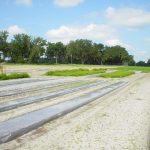
Tomato growers who utilize high tunnels to reach early markets often find that there are few economic alternatives to tomato. Therefore, many growers grow tomatoes after tomatoes instead of rotating to a different crop. The repeated cropping of tomato in the same area can lead to disease problems such as Fusarium crown rot and white…Read more about Soil Solarization[Read More]
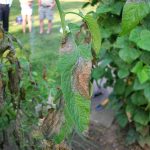
Late blight has been reported on potatoes and tomatoes in LaGrange County.Potato and tomato growers in northern Indiana should follow the management recommendations listed below and in the Midwest Vegetable Production Guide for Commercial Growers 2015 (ID-56). Late blight thrives under cool, wet conditions. The disease can easily spread from plant to plant. Under ideal…Read more about Late Blight in LaGrange County[Read More]
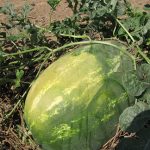
Loss of foliage due to poor growing conditions or disease can cause fruit to be exposed to the sun. Hot temperatures and direct sunlight can lead to areas of the fruit that appear bleached or sunburned. Sunburned fruit may not be marketable. To reduce the probability sunburned fruit, every effort should be made to maintain foliage…Read more about Sunburn on Vegetables[Read More]
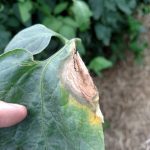
Gray mold of tomato is one of the more common diseases of greenhouse-produced tomatoes. Although it is often a minor problem, if left unchecked, gray mold can cause yield loss. Gray mold, or more properly, Botrytis gray mold, often causes a light gray or brown necrotic lesion on leaves (Figure 1). The lesions on leaves are sometimes…Read more about Botrytis Gray Mold of Tomato[Read More]
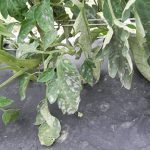
This disease has been reported near West Lafayette and in Wanatah Indiana. Powdery mildew of tomato can be recognized by the white fungal colonies on both leaf surfaces (Figure 1). Occasionally, stems may also be infected. Severely affected tomato plants may have leaves that turn chlorotic and necrotic. Fruit will not be directly affected. The causal organism has been…Read more about Powdery Mildew of Tomato[Read More]

Pinney Purdue Vegetable Field Day and Sweet Corn Sampler. Thursday, August 13, 2015. 4:00 p.m. – 8:00 p.m. CDT. Pinney Purdue Ag Center, 11402 S. County Line Rd., Wanatah, IN. Plot tours include soil health management and disease suppressive soils, tomatoes and peppers in high tunnels, and sweet corn varieties. Private Applicator Recertification (PARP) Credit…Read more about Upcoming Events[Read More]
In years past, the European corn borer was the most important pest of sweet corn, as well as being a pest of peppers and other vegetables. Since the advent of Bt field corn, the overall population of corn borers has been dramatically suppressed, so far that we often forget about it being a pest of…Read more about European Corn Borer[Read More]
I’ve seen some substantial populations of potato leafhoppers recently. Leafhoppers can be a significant pest of a number of vegetable crops, with potato and snap beans being particularly affected. Look for adults flitting off the plants when they are disturbed and for nymphs feeding on the underside of the leaves. It is important not to…Read more about Potato Leafhopper[Read More]
Yellowstriped armyworms continue to cause problems for tomato growers, especially in high tunnels. The populations are often spotty within a field or high tunnel, but can easily reach damaging levels. Most of the insecticides listed in the Midwest Vegetable Production Guide for control of caterpillars on fruiting vegetables (pages 135-6) will control yellowstriped armyworms. If…Read more about Yellowstriped Armyworm[Read More]