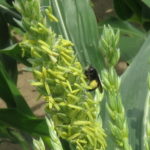
The sweet corn variety plots at Pinney Purdue provide a good chance to observe sweet corn insects. In late July I observed two caterpillars that surprised me. The first was European Corn Borer (ECB), in the tassel where they are often found (Figures 1 & 2). It was a surprise because I have seen many…Read more about Sweet Corn Insect Observations[Read More]
Sweet Corn
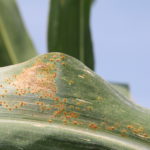
This article is modified from Darcy Telenko’s article about field corn in a recent Purdue Pest and Crop newsletter. Southern rust of corn is normally a disease of tropical areas. During summer months, however, the fungus which causes southern rust, Puccinia polysora, may move into Indiana or other Midwestern states. Southern rust has officially been confirmed…Read more about Southern Rust on Sweet Corn in Indiana[Read More]
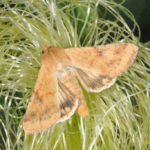
We have begun our state-wide trapping and monitoring program for corn earworm (Figure 1). The latest trap catch information can be found here. Traps have been placed at each of the eight Purdue Agricultural Centers throughout the state. Trap catches at the reporting farms are already in the double digits. Please refer to E-31 to…Read more about Corn Earworm Trapping is Underway[Read More]
The USDA lab out of Wooster, Ohio is interested in surveying Indiana sweet corn for virus. They are especially interested in sweet corn near johnsongrass, but other fields are ok too. If you are interested, please let me know or contact Mark Jones, USDA Agronomist,mark.jones@ars.usda.gov, (330) 202-3555 ext. 2837. Your participation would be pretty simple:…Read more about Sweet Corn Virus Survey[Read More]
After harvest, storing vegetables in optimal conditions is important to ensure the whole season’s hard work has paid off. This article discusses the optimum storage conditions for tomato, pepper, cucumber, watermelon, cantaloupe and sweet corn. Tomato Ideal storage conditions for tomatoes depend on the maturity stage of picking. If tomatoes are picked at mature green,…Read more about Optimal Storage Conditions for Vegetables[Read More]

We are looking for sweet corn growers to participate in our 2017 Vegetable Field Day and Sweet Corn Tasting. Our field day on Aug. 15 at Pinney Purdue Ag Center in Wanatah, will feature tours of tomato production in moveable high tunnels, using both conventional and organic management systems. The event also will include walking tours…Read more about Call for Sweet Corn for Tasting Event[Read More]
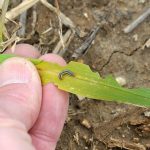
We have had major flights of armyworm moths (Figure 1.), as evidenced by pheromone trap catches. Catches have been highest in the northeastern portion of the state. Armyworms prefer grasses but will feed on other crops if necessary. During outbreak years, the infestation usually will start in pastures or other grassy areas. Once the armyworms…Read more about Armyworms[Read More]
Corn earworm flights are quite variable around the state, but are generally heavy. Counts in pheromone traps are higher in the northern part of the state, with the LaPorte County trap reporting 1422 moths over a 7 day period last week. That’s about 20 X the threshold level. As I wrote in the last newsletter,…Read more about Corn Earworms[Read More]
I continue to catch low numbers of corn earworm moths in my pheromone trap. Although the numbers are low, growers with very early sweet corn that is in the reproductive stage should be alert for potential damage. The threshold for spraying sweet corn that matures prior to field corn silking is only one moth per…Read more about Corn Earworm[Read More]
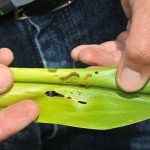
I am continuing to catch a small number of corn earworms in my trap. Usually we talk about earworm moths being attracted to silking corn to lay their eggs. However, moths will lay eggs on whorl stage sweet corn and the larvae can cause damage (Figure 1 and 2). The larvae will often feed inside…Read more about Corn Earworm[Read More]