
The 2026 Northwest Indiana Vegetable Farmer Workshop will be held on February 2, 2026, 1:00 – 4:00 PM Central Time at the Porter County Public Library, 103 Jefferson Street, Valparaiso, IN. Save the date and register now! Register: https://purdue.ca1.qualtrics.com/jfe/form/SV_9vILKOLOj3T7nDw. PARP and CCH credits expected. Payments for PARP credits should be made in advance by mailing a…Read more about 2026 Northwest Indiana Vegetable Farmer Workshop[Read More]
Insect and Mite Management
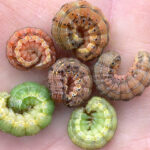
Corn Earworm https://extension.entm.purdue.edu/veg/cornearworm/ Our dent corn is through with pollination, leaving only our late plantings of sweet corn as a resource for the abundant moths in the landscape. Our thresholds are back down to 1 moth per night AND green silk on the plant to trigger a pesticide application. Did you know that corn earworm…Read more about Insect Trapping Updates[Read More]
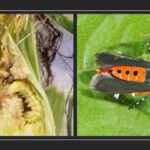
Squash Vine Borer https://extension.entm.purdue.edu/veg/squash-vine-borer/ The number of participants reporting trap catches has declined dramatically. Clinton, Allen, and Henry Counties are consistently reporting 1-4 moths per night. It seems that these populations didn’t get the memo that they are supposed to coordinate their mating during one concentrated time point in the summer. Regardless, at this…Read more about Insect Trapping Updates[Read More]
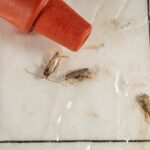
If you are a high tunnel tomato grower, you may have encountered small, blotchy leaf mines (Figure 1) or tiny brown mottled moths (Figure 2) on your plants in the past few years. These tiny pests are the tomato pinworm, Keiferia lycopersicella (family Gelechiidae). They should not be confused with the leaf mining fly, Liromyza…Read more about Insect Spotlight: Tomato Pinworm[Read More]

A familiar and dreaded sight of any home gardener is to find their rose bushes in a state of disrepair. Leaves skeletonized, flowers destroyed, and the remains crawling with iridescent green and brown beetles. This is the result of a Japanese beetle infestation. Japanese beetles were introduced to the United States around the turn of…Read more about Insect Spotlight: Japanese Beetles[Read More]
Squash Vine Borer More information available at https://extension.entm.purdue.edu/veg/squash-vine-borer/ For those trappers who are currently reporting, we can see that our first generation of active adult moths is declining. Corn Earworm More information available at https://extension.entm.purdue.edu/veg/cornearworm/ Montgomery County is still holding the record (La Porte did get the closest), but counts have dropped dramatically. We are…Read more about Insect Trapping Updates[Read More]
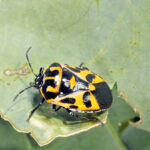
If you haven’t had the pleasure, please allow me to introduce you to the Harlequin bug, Murgantia histronica (Figure 1). This true bug (Order Hemiptera) is equipped with piercing-sucking mouthparts and has a preference for feeding on brassica crops. Unfortunately for us, their feeding results in white blotches on the leaf tissues (Figure 2), and…Read more about Insect Spotlight: Meet the Harlequin Bug![Read More]
Pheromone trap monitoring of corn earworm (Helicoverpa zea) and squash vine borer (Melittia cucurbitae) is underway throughout the state. Utilizing trap catches in your area can help inform management decisions and avoid unnecessary pesticide applications. Squash Vine Borer (https://extension.entm.purdue.edu/veg/squash-vine-borer/) For those trappers who are currently reporting, we are catching moths regularly in Allen, Marion, and…Read more about Insect Trapping Updates[Read More]
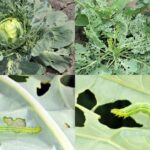
Trichoplusia ni, commonly known as the cabbage looper, is a moth in the family Noctuidae. Native to North America, it is a polyphagous pest (feeds on lots of different plants) that can cause significant damage in a variety of crops and potentially lead to plant death. While cabbage looper has a large geographical distribution, it…Read more about Insect Spotlight: Cabbage Looper[Read More]

Description The seedcorn maggot, or Delia platura, is a frequent pest in the Anthomyiidae family that can affect both specialty and agronomic crops, including corn, melons, onions, pumpkins, and many others. The larvae, or maggots, of this species damage the crops. The larvae tend to be white or translucent in color, about 1/4 inch long,…Read more about Insect Spotlight: Seedcorn Maggot[Read More]