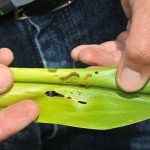
I am continuing to catch a small number of corn earworms in my trap. Usually we talk about earworm moths being attracted to silking corn to lay their eggs. However, moths will lay eggs on whorl stage sweet corn and the larvae can cause damage (Figure 1 and 2). The larvae will often feed inside…Read more about Corn Earworm[Read More]
Insect and Mite Management
As predicted last week, I have received a number of reports of damage to various vegetables from the root and seed maggots. These pests need to be managed preventively. First, by limiting the amount of decaying organic matter (cover crops, compost, manure) that attracts the flies, growers can reduce the number of eggs laid. Second,…Read more about Root and Seed Maggots[Read More]
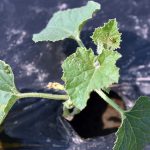
We found our first striped cucumber beetle on Friday, May 20 and several more on May 23 (Figure 1). Given the cool weather, this is a little earlier than we would have expected. As the temperatures warm up this week, it would not be surprising for cucumber beetles to become very numerous in our melon…Read more about Striped Cucumber Beetles[Read More]
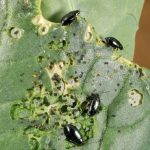
Many of our vegetable crops are subject to feeding by one or more species of flea beetles (Figure 1). Flea beetles get their name because they have enlarged hind legs that allow them to jump like fleas. Most species are quite small, and with their ability to jump, often seem to just disappear when disturbed….Read more about Flea Beetles[Read More]

I caught my first earworm (Figure 1) moth in a pheromone trap last week. Earworms are very polyphagous, meaning they will eat lots of different plants. I suspect that any females that are flying are laying their eggs on wild plants of some sort and not on the seedling stage sweet corn or dent corn that…Read more about Corn Earworm[Read More]
The cool, wet weather we are experiencing is perfect for the root and seed maggots, namely cabbage maggot, onion maggot, and seedcorn maggot. One way of avoiding damage from these pests is to wait until the soils warm up to 70o F before planting, but that is not always possible. The use of row covers…Read more about Root and Seed Maggots[Read More]
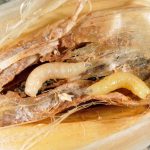
Three species of seed and root maggots attack vegetables in Indiana. The seedcorn maggot (Figure 1) feeds on seeds and seedlings of sweetcorn, cucurbits, lima and snap beans, peas, and other crops. Cabbage maggots can cause serious damage to transplants of cabbage, broccoli, cauliflower, and Brussels sprouts and make the fleshy roots of radishes, turnips,…Read more about Seed and Root Maggots[Read More]
In recent years, many seed companies have begun using the neonicotinoid insecticide thiamethoxam (FarMore) as a seed treatment on cucurbit and other vegetable seeds. Thiamethoxam is a systemic insecticide that moves from the seed coat into the seedling and then moves throughout the plant. Research has shown that these seed treatments provide about 3 weeks…Read more about Neonicotinoid Seed Treatment on Cucurbits[Read More]
One way insects communicate with individuals of the same species is with pheromones. Pheromones are volatile chemicals released by an insect that usually can be detected only by individuals of the same species. There are a number of different types of pheromones, but the most common type is the sex pheromone. Usually the females will…Read more about Pheromones and Pheromone Traps[Read More]
Catches of corn earworm moths in pheromone traps are gradually increasing. I had 18 in my trap this morning (August 18). The gradual increase is indicative of the local population emerging. We can expect them to continue to gradually increase for most of the remainder of the season. What we have not had is the…Read more about Corn Earworm[Read More]