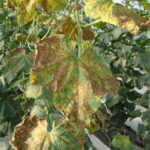
Downy mildew has been observed in Adam County in northern Indiana on cucumber. In addition, downy mildew on cucumber has been reported in southern Michigan and northern Ohio. Growers in northern Indiana should manage for downy mildew on valuable cucurbit crops. Growers throughout the state should scout for the disease. Growers should assume that all…Read more about Downy Mildew of Cucurbits[Read More]
Plant Disease Management
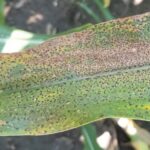
This disease is a relatively new disease to Indiana. So far, it has mostly affected field corn. However, tar spot was recently observed on sweet corn. This article will discuss the symptoms, biology and management of tar spot of sweet corn. Tar spot causes dark, mostly circular lesions on the leaves, stalks and husks of…Read more about Tar Spot of Sweet Corn[Read More]
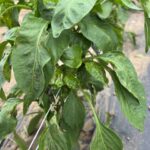
The first symptom of bacterial spot of pepper that is usually noticed is the lesions on the leaves. These lesions are irregular to round in shape and brown and are associated with chlorosis. Lesions are usually water-soaked (Figure 1). In severe cases, the fruit may be affected. The lesions on fruit are often raised (Figure…Read more about Bacterial Spot of Pepper[Read More]
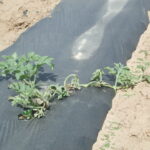
Fusarium wilt of watermelon is one of the most economically important diseases of watermelon in the Midwest. Fusarium wilt typically shows up in watermelon fields just after Memorial Day. This year is no different. After a brief description of the symptoms of the disease, this article will discuss the pluses and minuses of possible fungicide…Read more about Fungicides for Fusarium wilt of Watermelon after Symptoms?[Read More]
As I write this, scattered showers are moving through much of southern Indiana. It is unclear yet how much moisture these showers will produce for any given area. What is clear is that May and June have been unusually dry for most of Indiana. How will this dry spell affect overall disease pressure for the…Read more about Dry Weather and Fungicide Applications[Read More]
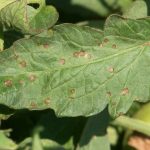
There are a number of factors that go into scheduling foliar fungicide applications. For example, choosing a product with your crop and suspected disease on the label is a must. You will want to select a product with good efficacy. It is important to choose a product with a Pre-Harvest Interval (PHI) and Re-Entry Interval…Read more about Alternating Fungicides to Avoid Fungicide Resistance[Read More]
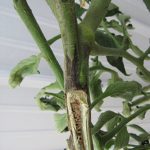
Tomato pith necrosis is a bacterial disease of tomatoes that occurs sporadically, usually in greenhouses or high tunnels. While this disease can kill or at least ruin marketable yield on tomatoes, the disease usually affects perhaps only a handful of plants in a greenhouse. That is, the disease does not seem to spread beyond the…Read more about Tomato pith necrosis[Read More]

This article was originally written by Dan Egel, who retired from Purdue. Please contact the PPDL for more information. MELCAST is a weather-based disease-forecasting program that helps growers schedule foliar fungicide applications for cantaloupe and watermelon. MELCAST stands for MELon disease for CASTer. This program, designed by Dr. Rick Latin, Professor Emeritus of Plant Pathology at…Read more about Melon Disease Forecaster 2024[Read More]

The most recent two podcast episodes of the Strawberry Chat focus on spring weed and disease management. Spring Weed Management Podcast Kevin Schooley and Stephen Meyers joined the discussion to talk about weeds and weed management in matted-row and plasticulture strawberry production. Steve spoke about weeds commonly seen in strawberry fields and gave us a…Read more about Strawberry Podcasts on Spring Weed and Disease Management[Read More]
Dr. Janna Beckerman, Professor and Extension Plant Pathologist in the Dept. of Botany and Plant Pathology joined our discussion to talk about Spring Diseases and Management. Our discussion focused on Anthracnose fruit rot and Botrytis fruit rot. Janna described the biology of the pathogens and provided cultural and fungicide recommendations for managing these diseases. You…Read more about Strawberry Chat Podcast — Strawberry Spring Diseases and Management[Read More]