
A new strain of the disease anthracnose of pepper has been detected in South Carolina and Ontario, Canada. Although this disease has not been found in Indiana, the article reprinted below will help growers to be aware of this potential problem. Pay close attention to the description of the disease and the photo. Don’t hesitate…Read more about Anthracnose Management in Peppers – the Old and the New[Read More]
Plant Disease Management
PCNB fungicides include Blocker 4F® and 10G®. PCNB is an acronym for the chemical pentachloronitrobenzene. In Indiana, PCNB fungicides are used for bottom rot, club root, and wirestem in brassica crops. Brassica crops for which PCNB products are labeled for include: Broccoli, Brussels sprout, cabbage, cauliflower, collards, kale, kohlrabi, and mustard greens. Be sure to…Read more about EPA Proposal to Cancel all uses of PCNB Fungicides[Read More]
Vegetable growers may be wondering when to apply the final fungicide application. It is important to leave the crop protected until the last harvest. Yet, it is important not to waste fungicides. In most cases, the last fungicide application should occur 10 to 14 days from the final harvest. Most fungicides that are designed to…Read more about The Final Fungicide Application[Read More]
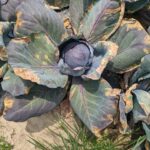
I have observed the disease black rot of cabbage and broccoli this year. I have discussed the basics of this disease in April (Issue 701). Here, I would like to share some photos and observations. For a brief background, black rot is a bacterial disease that becomes systemic-that is, moves within the plant. The disease…Read more about Black rot of Brassica Crops[Read More]

Recently, I have observed several pumpkin vines and fruit with Plectosporium blight. When I receive phone calls about Plectosporium blight, the caller often has trouble describing the disease. Indeed, the disease is difficult to describe. Therefore, I will include several photos with this article. Lesions of Plectosporium blight are most often observed on the stems…Read more about Plectosporium Blight of Pumpkin[Read More]
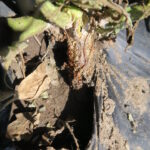
Southern blight of pepper and tomato thrives under hot, dry conditions. Usually, such conditions are more likely in August. Production under tunnels may contribute to the dry conditions that influences southern blight. This article will discuss the symptoms, biology and management of southern blight of tomato. Southern blight has a wide host range affecting many vegetable,…Read more about Southern Blight of Tomato and Pepper[Read More]
Recent heavy rains have caused an increase in foliar disease in many vegetable fields. A sudden increase in foliar disease may lead some growers to purchase expensive fungicides to take care of the problem. However, there are several considerations before one applies the most expensive fungicide. The optimum time to apply a very effective, and…Read more about Late Season Fungicide Applications[Read More]
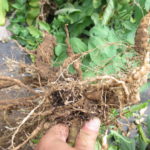
Root-knot nematodes (RKN) are a devasting soilborne pest on a wide range of vegetables and fruits. Root-knot nematode infections result in root swellings called galls (Figure 1). Heavily infected crops by RKN display aboveground symptoms such as stunted growth, wilting, and leaf yellowing. We often found root-knot nematode causes damage to watermelons, cantaloupes, and tomatoes…Read more about Root-knot Nematode on Vegetable Crops[Read More]
This is the fourth article in a series that describes the three primary bacterial diseases of tomato: bacterial canker, bacterial speck and bacterial spot. This article is a general summary of management options for these diseases. All three of these diseases may be seed borne and brought into to field situation on transplants. It is…Read more about General Management Options for Bacterial Diseases of Tomato[Read More]
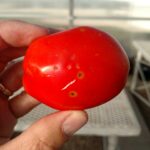
The following is an article in one of a series about bacterial diseases of tomato. Previously, articles about bacterial canker and bacterial spot have been featured here. The next article will be about general management methods for bacterial diseases of tomato. Bacterial speck causes lesions on all above ground portions of the tomato, in a…Read more about Bacterial Speck of Tomato[Read More]