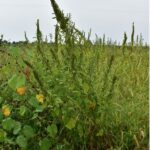
Common names: common waterhemp, tall waterhemp Latin name: Amaranthus tuberculatus Family: Amaranthaceae (pigweed family) General description and identification Waterhemp is an upright, tall, summer annual herbaceous plant. It is native to the United States and has historically been found in waterways and floodplains. Today, waterhemp is often found in disturbed habitats, such as agricultural fields….Read more about Weed Spotlight: Waterhemp[Read More]
Spotlight

A familiar and dreaded sight of any home gardener is to find their rose bushes in a state of disrepair. Leaves skeletonized, flowers destroyed, and the remains crawling with iridescent green and brown beetles. This is the result of a Japanese beetle infestation. Japanese beetles were introduced to the United States around the turn of…Read more about Insect Spotlight: Japanese Beetles[Read More]
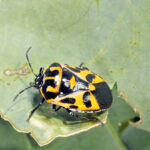
If you haven’t had the pleasure, please allow me to introduce you to the Harlequin bug, Murgantia histronica (Figure 1). This true bug (Order Hemiptera) is equipped with piercing-sucking mouthparts and has a preference for feeding on brassica crops. Unfortunately for us, their feeding results in white blotches on the leaf tissues (Figure 2), and…Read more about Insect Spotlight: Meet the Harlequin Bug![Read More]
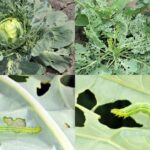
Trichoplusia ni, commonly known as the cabbage looper, is a moth in the family Noctuidae. Native to North America, it is a polyphagous pest (feeds on lots of different plants) that can cause significant damage in a variety of crops and potentially lead to plant death. While cabbage looper has a large geographical distribution, it…Read more about Insect Spotlight: Cabbage Looper[Read More]
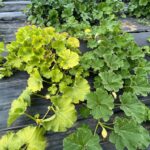
Introduction Cucurbit yellow vine disease (CYVD) is an emergent disease in the United States caused by the bacterium Serratia ureilytica, and it commonly affects zucchini, squash, watermelon, and melons. The pathogen that causes CYVD is transmitted by the squash bug (Anasa tristis, Figure 1), and other potential vectors include the striped cucumber beetle (Acalymma vittatum)…Read more about Pathogen Spotlight: Serratia ureilytica Causing Cucurbit Yellow Vine Disease[Read More]
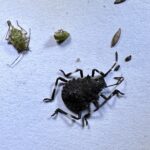
Lygus is a genus of insects within the family Miridae (Order: Hemiptera, piercing-sucking true bugs) that often feed on common horticultural crops. These small insects have rather large eyes, heavily patterned, neutrally colored wings, and long, spindly antennae. The diet of Lygus bugs, as they are colloquially called, is incredibly diverse, ranging from cotton and…Read more about Insect Spotlight: Lygus Bugs[Read More]
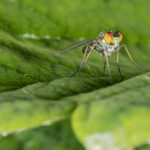
This year, we really want to familiarize our readers with beneficial flies! After learning about syrphids, blow flies, and predatory gall midges, we are going to end the season on long-legged flies (Figures 1 and 2)). Unlike the other species we have discussed this year, the family of long-legged flies (Dolichopodidae) contain numerous species which…Read more about Insect Spotlight: Long-legged flies[Read More]
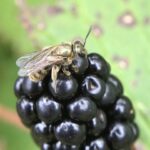
Lasioglossum sweat bees are common pollinators in agricultural landscapes. These bees are small black, brown, or iridescent green/blue bees that belong to the family Halictidae. They can often be mistaken for flies due to their small size and nondescript appearance compared to other bees. These bees are historically overlooked as important pollinators for crops compared…Read more about Insect Spotlight: Lasioglossum Sweat Bees[Read More]
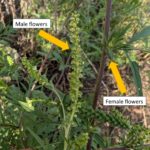
Common names: Common ragweed, annual ragweed, hogweed, hay-fever weed, Roman wormweed, and bitterweed. Latin name: Ambrosia artemisiifolia L. “Ambrosia” is from Greek mythology and refers to the food or drink of the gods, often associated with granting immortality. Meanwhile, “artemisiifolia” indicates that the foliage of common ragweed looks like the foliage of plants from the…Read more about Weed Sptolight: Common Ragweed[Read More]
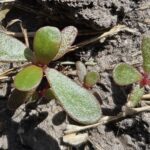
Common names: purslane, pusley, pursley, wild portulaca, common portulaca, little hooweed, low pigweed Latin name: Portulaca oleracea L. Family: Portulacaceae (Purslane family) Life Cycle Common purslane is a summer annual that extends along the ground with its thick, fleshy stems and leaves (Figure 1). Thanks to its ability to reproduce not only by seeds but…Read more about Weed Spotlight: Common Purslane[Read More]