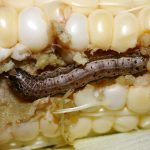
Fall armyworms (Figure 1) are only able to survive the winter in extreme southern US, along the Gulf Coast and in Florida. Fall armyworms tend to migrate northward gradually, with each successive generation moving several hundred miles further north. They reach Indiana every year, but their populations are unpredictable in numbers and location. This week…Read more about Fall Armyworms[Read More]
For many vegetable growers, the season is in full swing. All that hard work in season preparation, planting and maintenance is paying off with harvest. One of the on-going season maintenance issues is applying fungicides. In other articles, I have described how and when to spray. In this article, I want to address when to stop. To limit the scope…Read more about When to Stop Spraying Fungicide[Read More]
Corn earworm moth catches continue to be quite low in most areas of the state. Typically, we see an upsurge in activity during the first two weeks of August. With populations as low as they are and most field corn still with attractive silks, sweet corn growers can get by with minimal spray programs now….Read more about Corn Earworm[Read More]
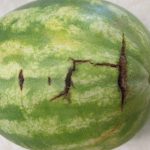
Cross stitch of watermelons is a physiological disorder (not caused by an infectious disease) first reported in 1990s on watermelon fruit. It received the name because the symptom looks like cross stitch. One or more rows of oval-shaped lesions lie along with the longitudinal axis of the fruit. These lesions are normally more close to…Read more about Cross Stitch of Watermelons[Read More]
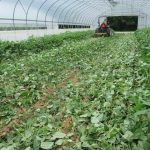
We have grown strawberries from Aug, 2015 to May, 2016 in one of our high tunnels at Southwest Purdue Agricultural Center. After taking the strawberry plants out of the high tunnel in the end of May, we did have enough time to grow a warm-season crop, like cucumbers. However, because for most of us June…Read more about A Case Study: What Cover Crops Could Achieve in High Tunnels in the Middle of Summer?[Read More]
A group of entomologists and others, led by Dr. Ian Kaplan from the Department of Entomology, recently received funding from the Specialty Crop Research Initiative from USDA/NIFA for $3,673,611 to study “Navigating the Trade-off Between Pest Management and Pollinator Conservation in Cucurbits.” The grant will begin September 1, 2016 and run for 5 years. The…Read more about Purdue Needs Growers for Pollinator Health Study[Read More]
High Tunnel Tour at SWPAC Date: August 22, 2016 7:00 PM to 8:30 PM Location: Southwest Purdue Agricultural Center, 4369 North Purdue Road, Vincennes, IN 47591 Please join us for a high tunnel tour at the Southwest Purdue Ag Center. You will learn about high tunnel tomato diseases and management, end of season field sanitation, potential…Read more about Upcoming Events[Read More]
Purdue University prohibits discrimination against any member of the University community on the basis of race, religion, color, sex, age, national origin or ancestry, genetic information, marital status, parental status, sexual orientation, gender identity and expression, disability, or status as a veteran. This material may be available in alternative formats. 1-888-EXT-INFO Disclaimer: Reference to products in this publication is not intended to be an endorsement to the exclusion of others which may have similar uses. Any person using products listed in this publication assumes full responsibility for their use in accordance with current directions of the manufacturer.