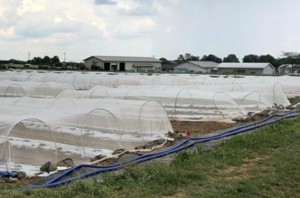
We are conducting a survey to learn about your experiences using row covers and your willingness to adopt a new row cover approach known as mesotunnels. Our study is evaluating the use of mesotunnels in the eastern half of the US for control of the full range of pests and diseases on organic production of[Read More…]
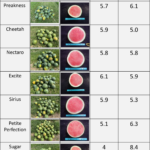
We conduct standard seedless watermelon variety trials at Southwest Purdue Agricultural Center each year. In a separate trial, we evaluate mini seedless watermelon varieties. Mini watermelons refer to fruit ranging from 4.4 to 8.8 lbs, although the industry considers 6-7 lbs fruits ideal. Fruit in a wide range of sizes is suitable to sell at[Read More…]
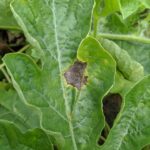
3Gummy stem blight is an important disease of cucurbits in the Midwest. Gummy stem blight can cause lesions on leaves and stems of cantaloupe, watermelon and other cucurbits. Fruit lesions may be observed on pumpkin and, occasionally, on cantaloupe. Fruit lesions are known as black rot. Find more information about gummy stem blight and black[Read More…]
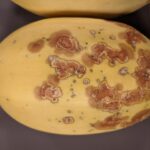
The photo here (Figure 1) shows a spaghetti squash with many lesions on the fruit. At first glance, it may seem to be several lesions of different sizes. However, if one looks closely, there are actually two different diseases on the fruit. The larger, brown, irregular water-soaked areas are black rot, caused by the same[Read More…]
Date: November 18, 2021, 5:00 pm (EST) Location: 4207 Purdue Rd, Vincennes, IN 47591. Purdue Extension Food Safety Training Hub, in the newly constructed Vincennes University Agricultural Center, located on highway 41 adjacent to Southwest Purdue Agriculture Center. The Southwest Indiana Melon and Vegetable Growers Winter Meeting will be back in person in 2021! Note the new[Read More…]
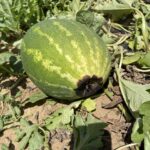
Supported by Indiana Vegetable Growers Association and Illiana Watermelon Association, a collaborative project between Purdue University and Michigan State University that aims to help watermelon farmers improve irrigation management was recently funded. In this project, the team will conduct the scientific experiment at the Southwest Purdue Agricultural Center to test currently used irrigation management tools,[Read More…]
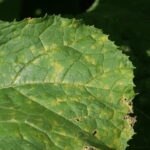
Downy mildew of cucumbers has been observed in Knox County. This disease has not been observed on pumpkins, but it is possible for downy mildew to spread from cucumbers to pumpkins. Therefore, pumpkin growers should scout for downy mildew and manage for the disease depending on their situation. Pumpkin growers who plan to harvest mid[Read More…]
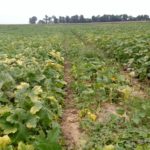
In the last several days I have received complaints of pumpkin plants with yellow leaves. Growers want to know if the yellow is a symptom of disease and what can be done about it. Yellow lesions on leaves may be symptoms of disease. There can be many reasons why pumpkin plants have yellow leaves. Usually,[Read More…]
Downy mildew has been observed in Knox County on cucumber. In addition, downy mildew on cucumber has been reported in central Michigan on cucumber and central and northern Ohio on cucumber and cantaloupe. The downy mildew race type found in Knox county that goes to cucumber and cantaloupe may also go to other cucurbits such[Read More…]
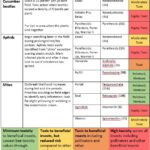
Unfortunately, pests don’t know when to take the day off. Even though we have bees in the field and watermelons reaching peak bloom, we still need to watch out for pest infestation and disease outbreaks. First and foremost, scouting fields to monitor pests will ensure that infestations never reach high enough populations to threaten yield.[Read More…]