
The Annual Fall/Winter Meeting of the Southwest Indiana Melon and Vegetable Growers is scheduled on Monday, November 30, 2020, 3:00 pm – 5:00 pm (EST). This meeting will be held online this year because of COVID-19 restrictions. Dr. Wenjing Guan and Dr. Dan Egel will discuss the results of the 2020 watermelon and cantaloupe variety[Read More…]
Found 251 Articles
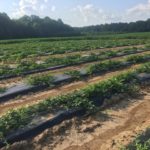
Thanks to growers’ collaboration and help from Superior Ag, we collected plant tissue samples from 12 watermelon fields at different crop growing stages in Southern Indiana in the 2020 season. In a previous article, we discussed results about magnesium and potassium. In this article, we will discuss another nutrient, Sulfur (S). Sulfur deficiency has become[Read More…]
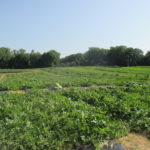
This article addresses considerations of using grafted watermelon plants in Indiana. Choosing rootstocks Interspecific hybrid squash is the most widely used watermelon rootstock. Many cultivars of the hybrid squash rootstocks that have been developed by different companies, share similar genetic background and thus similar characteristics. All of them have outstanding resistance to Fusarium wilt, but,[Read More…]
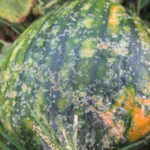
This time of year you are likely getting bogged down in the fight against pests. The accumulation of plant pathogens, insects, and climatic conditions favoring their growth can make the last few weeks of harvest feel like the toughest point in the battle. For cucurbit growers in particular, there are a number of insect pests[Read More…]
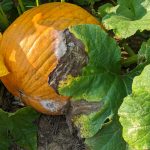
Phytophthora blight was a serious disease this past season. As a result, I have had many questions about managing this disease. The following article is an update of a previous article on this subject. The questions I have been asked have ranged from what do I spray to how does this disease work? Therefore, I[Read More…]
Thanks to growers’ collaboration and help from Superior Ag, we collected plant tissue samples from 12 watermelon fields at different crop growing stages in Southern Indiana in the 2020 season. In this article, I want to discuss two of the issues that standout from these tests. One is the generally low or deficient Magnesium (Mg)[Read More…]
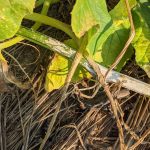
This disease appears to be more important each year. It is not clear to me why. This article reviews Plectosporium of pumpkin, sometimes called white speck. I would rank Plectosporium blight behind powdery mildew, bacterial leaf spot and Phytophthora blight in economic damage caused. The occurrence of this disease is usually sporadic. However, when it[Read More…]
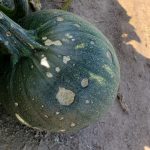
Question: What happened to these fruit? Answer: Hail damage. A storm that happened in middle July brought hail to parts of Indiana. Hail hit small fruit, and damage became pronounced as fruit grow. More information about the damage to vegetable crops can be found in the article Hail Damage published in Vegetable Crops Hotline Issue[Read More…]
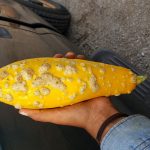
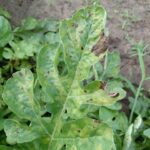
Downy mildew has been observed in LaPorte County in northern Indiana on cucumber. In addition, downy mildew on cucumber has been reported in southern Kentucky and on watermelon in the Kansas City area of Kansas. Growers in northern Indiana should manage for downy mildew on valuable cucurbit crops (Figure 1). Growers throughout the state should[Read More…]
It is the policy of the Purdue University that all persons have equal opportunity and access to its educational programs, services, activities, and facilities without regard to race, religion, color, sex, age, national origin or ancestry, marital status, parental status, sexual orientation, disability or status as a veteran. Purdue is an Affirmative Action Institution. This material may be available in alternative formats. 1-888-EXT-INFO Disclaimer: Reference to products in this publication is not intended to be an endorsement to the exclusion of others which may have similar uses. Any person using products listed in this publication assumes full responsibility for their use in accordance with current directions of the manufacturer.