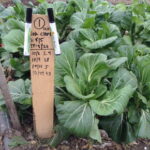
A lot of things are different this year. With the changes come opportunities to try something new. Liz Brownlee with Hoosier Young Farmers Coalition mentioned to me that some markets, especially in rural areas, do not have a steady supply of Fall crops, and that farmers might be looking to extend the season with crops…Read more about Is This the Year to Try Fall Crops?[Read More]
Greens and Salad Crops
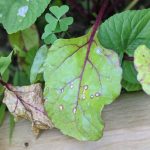
This disease was observed in a home garden recently on table beet (Figure 1). I was surprised considering how dry it has been. Cercospora leaf spot also affects swiss chard. Symptoms include circular leaf spots that may have a reddish margin. The center of the lesions may start off a light brown and turn to gray after the fungus (Cercospora beticola) begins to sporulate….Read more about Cercospora Leaf Spot of Beet[Read More]
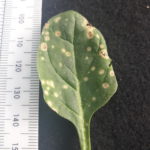
While many growers use high tunnels to extend the growing period for warm-season crops such as tomatoes or cucumbers, it is also possible to grow cool-season crops such as spinach well into winter. The winter over much of Indiana has been rather mild; spinach and other cool-season crops should be doing well. However, disease and…Read more about Cladosporium of Spinach[Read More]
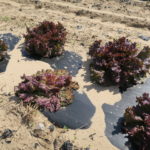
Although Indiana is not known for lettuce production, an increasing number of growers find that augmenting retail sales with leaf lettuce can be profitable. Since lettuce is a cool season crop, field planted leaf lettuce around Indiana may be reaching harvest stage. Leaf lettuce can generally be grown with few pests. However, lettuce drop was…Read more about Lettuce drop[Read More]
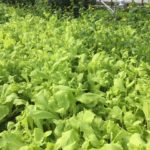
Bolting of crops overwintered in high tunnels is common in the spring. ‘Bolting’ refers to lengthening and blooming of the flowering stalk. Bolting is often a problem because the quality of the marketable part of the plant declines. Also, plants subject to bolting are programmed to die once they complete flowering and seed production so…Read more about Bolting and Blooming in High Tunnels[Read More]
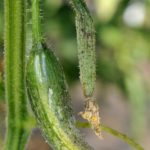
It’s that time of year, where we are prepping high tunnels and getting back into the full swing of production, slowly, here in the Midwest. Many of you have already begun to transplant and may have encountered your first pests on these new crops. Aphids are one that remain a problem in high tunnels, and…Read more about Aphids in High Tunnels[Read More]
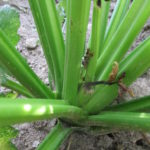
Blackheart of celery is a physiological disorder that causes significant crop loss in major celery production areas. It is characterized by the breakdown of young leaf tissues in the heart of the plants (Figure 1). The affected young tissues turn black, which give it the name “blackheart”. The cause of blackheart of celery is related…Read more about Blackheart of Celery[Read More]
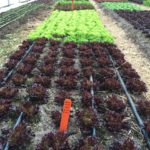
Winter farmers markets are becoming more and more popular. Lettuce is a primary type of vegetables grown for the market. As we are finishing up summer crops, it is a good time to learn and refresh knowledge about lettuce. This article discusses some of the basics of growing lettuce in high tunnels, as well as…Read more about Facts about Lettuce[Read More]
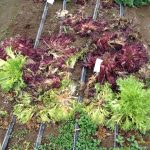
Some of the red and green multi-leaf lettuce plants in Figure 1 are wilted and closer inspection reveals death and soft decay at the crown and well as freeze damage (Figure 2). Getting even closer as in Figure 3 we see white fuzzy mold and find hard black sclerotia 1/8 to ¼ inch across and…Read more about Problems in Overwintered Salad Greens – White Mold and Tip Burn[Read More]
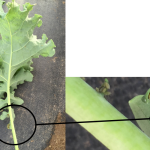
Aphids can be one of the most damaging and hard to control pests during the winter months in high tunnels. The first step to managing aphids is to develop a scouting plan. Aphids reproduce clonally and develop quickly leading to very large population build-up in a short period of time. Therefore scouting is recommended at…Read more about Aphid Management in Winter Green Production in High Tunnels[Read More]