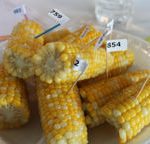
Pinney Purdue Vegetable Field Day and Sweet Corn Sampler. Thursday, August 13, 2015. 4:00 p.m. – 8:00 p.m. CDT. Pinney Purdue Ag Center, 11402 S. County Line Rd., Wanatah, IN. Plot tours include soil health management and disease suppressive soils, tomatoes and peppers in high tunnels, and sweet corn varieties. To register, contact Lori Jolly-Brown,…Read more about Upcoming Events – Pinney Purdue Vegetable Field Day and Sweet Corn Sampler[Read More]
Solanaceous Crops
We are again seeing a lull in pheromone trap catches of corn earworms. However, I caution sweet corn growers to remain vigilant in checking their traps. Populations can increase rapidly, especially if carried north on storm fronts from the Gulf Coast. It is also important to watch the development of the field corn around your…Read more about Corn Earworm[Read More]
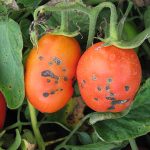
Bacterial spot of tomato causes lesions on foliage and fruit of tomato. On leaves, the lesions begin as small water soaked areas and turn into brown lesions with a yellow halo. Lesions on stems often lack a yellow halo. Fruit lesions, which are responsible for direct loss of marketable yield, are often scabby in appearance (Figure…Read more about Quintec Labeled for Bacterial Spot of Tomato[Read More]
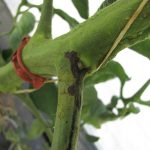
This disease has been reported in two different greenhouse situations. Although the disease is not usually economically important, a brief review of the disease is offered here to help tomato growers differentiate pith necrosis from more important problems. Tomato pith necrosis causes dark brown streaks on tomato stems and leaf petioles (Figure 1). Often stems may…Read more about Pith Necrosis of Tomato[Read More]
After a brief lull in pheromone trap catches, we have resumed catching earworm moths all around the state. Although most of the counts are relatively low (less than 10 per night), remember that for early planted sweet corn that silks before the neighboring field corn silks, the threshold for treatment is 1 moth per night….Read more about Corn Earworms[Read More]
Blossom end rot of tomato has been showing up in some protected growing structures. This article reviews the disorder and summarizes preventive practices. Blossom end rot is a physiological disorder caused by a deficient supply of calcium to the developing fruit. It is a common problem on tomatoes, but can also occur on peppers, eggplants,…Read more about Blossom End Rot of Tomato[Read More]
2015 marks the 40th year of my career as an entomologist and I still am surprised on a regular basis by how insects behave. I put out a corn earworm pheromone trap on May 14 and immediately caught 7 moths that night. Over the next three nights, I caught 36 moths. Typically, the few earworms…Read more about Corn Earworms[Read More]

Getting seedlings from the transplant tray into the field is essential for a good crop (Figure 1). Healthy transplants treated well will quickly establish themselves in the field, setting the foundation for a productive crop. Here I offer some suggestions for successful transplant establishment. Harden transplants by exposing them to higher light, cooler temperature, and…Read more about Successful Transplant Establishment[Read More]
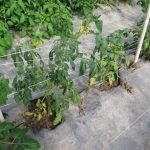
Symptoms of this disease include tomato plants with lower leaves that become yellow (chlorotic) and die; plants that begin to wilt; a lesion on the lower stem at ground level (Figures 1 and 2). If tomato plants are removed from the soil and carefully split open from the ground level, a discoloration of the vascular tissue…Read more about Fusarium Crown and Root Rot of Tomato[Read More]
Last year at the Southwest Purdue Agricultural Center (SWPAC) we conducted a tomato high tunnel trial described here. In this article, I would like to talk about the trial we will conduct in 2015, a repeat of the 2014 trial. In particular, I would like to talk about what we have done for fertility….Read more about Fertility for the Southwest Purdue Agricultural Center Tomato Trial[Read More]
Read more about Fertility for the Southwest Purdue Agricultural Center Tomato Trial