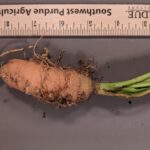
We announced in a previous newsletter article that we are doing a survey to understand the extent of root-knot nematode (RKN) damage on vegetable crops in Indiana. Among the 18 soil samples from high tunnels of 14 farms, RKNs (juvenile or adult) were found in 13 samples at 9 farms. Only 3 farmers knew RKN…Read more about Root-knot Nematode may be a Hidden Problem in High Tunnels[Read More]
Vegetable Crops - General
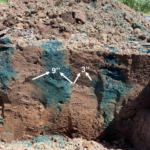
A major difference between drip irrigation and other irrigation methods is that drip irrigation applies water to only a portion of the soil. This works great for vegetables grown on the plastic mulch, since no irrigation water is applied between the row middles; water applied to row middles encourages weed growth. So, does the soil…Read more about Understanding Wetting Patterns in Drip Irrigation[Read More]

At Pinney Purdue (PPAC) 2.67 inches of rain fell July 27 through August 9. The potential evapotranspiration (PET) over the period was 1.68 inches. Estimates for water use by the crops are equal to or just slightly lower than potential evapotranspiration. For tomatoes, estimated water use was 1.68 inches, and for watermelons, 1.52 inches. There…Read more about Irrigation Demonstration Update Aug 9, 2022, Pinney Purdue Ag Center[Read More]
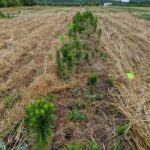
Attendees at a July field day at the Meigs Horticulture Research Farm in Lafayette, Indiana saw first-hand the potential of cover crops to suppress weeds in a SARE-funded demonstration plot. First, some background: Three cover crop species were sown with a ten-foot drill on September 10, 2021: Oats at 100 lb/acre Cereal rye at 65…Read more about Cover Crop Demonstration Plots Show Weed Suppression Potential[Read More]
Southern blight of pepper and tomato thrives under hot, dry conditions. Usually, such conditions are more likely in August. Production under tunnels may contribute to the dry conditions that influences southern blight. This article will discuss the symptoms, biology and management of southern blight of tomato. Southern blight has a wide host range affecting many vegetable,…Read more about Southern Blight of Tomato and Pepper[Read More]
Recent heavy rains have caused an increase in foliar disease in many vegetable fields. A sudden increase in foliar disease may lead some growers to purchase expensive fungicides to take care of the problem. However, there are several considerations before one applies the most expensive fungicide. The optimum time to apply a very effective, and…Read more about Late Season Fungicide Applications[Read More]
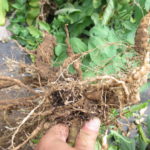
Root-knot nematodes (RKN) are a devasting soilborne pest on a wide range of vegetables and fruits. Root-knot nematode infections result in root swellings called galls (Figure 1). Heavily infected crops by RKN display aboveground symptoms such as stunted growth, wilting, and leaf yellowing. We often found root-knot nematode causes damage to watermelons, cantaloupes, and tomatoes…Read more about Root-knot Nematode on Vegetable Crops[Read More]

OISC Clean Sweep Pesticide Disposal Program is a great opportunity to legally dispose of unwanted pesticide products at little or no cost. The 2022 Clean Sweep Pesticide Disposal Program sponsored by the Office of the Indiana State Chemist (OISC) offers statewide pesticide collection sites in Wabash, Bartholomew, Daviess, Randolph, Porter and Hendricks counties in August. …Read more about OISC Clean Sweep Pesticide Disposal Program[Read More]
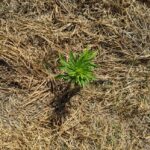
Try as we might, it seems that no weed management program controls 100% of the weeds in a field. Inadequate or excessive rainfall can limit the success of preemergence herbicides. Less-than-ideal soil moisture can result in unsatisfactory in-season cultivation. Even when we have effective herbicide options, late emerging weeds often cannot be treated within the…Read more about Going Rogue[Read More]
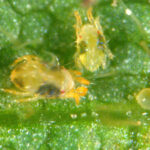
Two-spotted spider mites (TSSM) are one of the most common mite pests occurring throughout the world. They are known to feed on over 300 plant species, including tomatoes, cucumbers, melons, grapes, apples, and a variety of common flower and weed species. They disperse by walking or floating on the wind currents. Early infestations can be…Read more about Mite Management[Read More]