While the hard copy of the Midwest Vegetable Production Guide for Commercial Growers 2015 (ID-56) has been available since early January, the on-line version is updated as needed. Below I outline the latest changes. Page 40, Table 16. Several insecticide products were added to the “Insecticide Labeling for Greenhouse Use” table. Page 100, Cucurbit chapter….Read more about Updates to the Midwest Vegetable Production Guide, 2015[Read More]
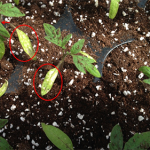
This is the time of year when growers often call to complain about tomato transplants that do not look right. One possibility is that the seedlings suffer from heater problems. In particular, tomato plants are very susceptible to damage from the gas ethylene. In Figure 1, some of the seedlings have leaves that are curled down and stems that are twisted (epinasty in…Read more about Ethylene Damage on Tomato[Read More]
Cover crops should be killed at least a couple of weeks before planting vegetables. That will give the cover time to partially decompose, and time for any cutworm larvae that may be in the crop to die or pupate. If wet weather delays killing or incorporation of cover crops, the time between incorporation and planting…Read more about Managing Cover Crops in Spring[Read More]
As you all know, many of our vegetable crops are dependent upon pollinators to move pollen from flower to flower. The cucurbits, muskmelons, cucumbers, watermelons, pumpkins, and squash, are completely dependent on insect pollination. Eggplant, okra, lima beans, and peppers will set fruit without pollinators but can have increased yield if pollinators are present. Honey…Read more about Honey Bees and Other Pollinators[Read More]

Background. Rapid growth in the craft beer industry is stimulating Indiana’s economy and creating an opportunity for Indiana farmers to start growing hops. In 2012, the Indiana craft brewing industry contributed over 600 million dollars to the state’s economy. The industry continues to grow, increasing from 63 breweries in 20131 to nearly 100 in 2015,…Read more about State of the Indiana Hops Industry[Read More]
(Information provided by Office of the Indiana State Chemist, 765-494-1492, www.oisc.purdue.edu) The Indiana Pesticide Clean Sweep Project designed to collect and dispose of suspended, canceled, banned, unusable, opened, unopened or just unwanted pesticides (weed killers, insecticides, rodenticides, fungicides, miticides, etc.) is being sponsored by the Office of Indiana State Chemist (OISC). This disposal service is…Read more about Plan to Dispose of Unwanted Pesticides[Read More]

Purdue Extension is starting the Indiana Food Hub Network this year. So what’s a food hub? The USDA working definition is “a centrally located facility with a business management structure facilitating the aggregation, storage, processing, distribution, and/or marketing of locally/regionally produced food products.” Extension educator Roy Ballard, who is workkng with Local Food Coordinator Jodee…Read more about Indiana Food Hub Email List[Read More]

Vegetable, fruit, and organic farmers can register their production areas on Driftwatch.org to let commercial pesticide applicators know where the fields are. Beekeepers can also register sites where beehives are located. Once sites are registered and approved they appear on the Driftwatch registry map (see Fig. 1) and partnering applicators are notified. This helps applicators…Read more about Are Your Fields Listed at Driftwatch.org?[Read More]

Purdue University prohibits discrimination against any member of the University community on the basis of race, religion, color, sex, age, national origin or ancestry, genetic information, marital status, parental status, sexual orientation, gender identity and expression, disability, or status as a veteran. This material may be available in alternative formats. 1-888-EXT-INFO Disclaimer: Reference to products in this publication is not intended to be an endorsement to the exclusion of others which may have similar uses. Any person using products listed in this publication assumes full responsibility for their use in accordance with current directions of the manufacturer.