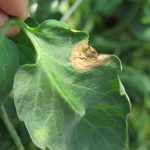
The recent cool and cloudy weather has influenced conditions in the field as well as in greenhouses and high tunnels. I have observed more Botrytis gray mold of tomatoes in greenhouses this spring than usual. This is due in part to the weather. This article will discuss this disease on tomatoes and some management options….Read more about Botrytis Gray Mold on Greenhouse Tomatoes[Read More]
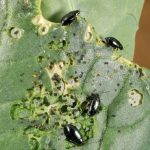
Many of our vegetable crops are subject to feeding by one or more species of flea beetles (Figure 1). Flea beetles get their name because they have enlarged hind legs that allow them to jump like fleas. Most species are quite small, and with their ability to jump, often seem to just disappear when disturbed….Read more about Flea Beetles[Read More]
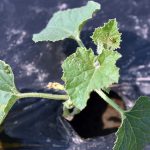
We found our first striped cucumber beetle on Friday, May 20 and several more on May 23 (Figure 1). Given the cool weather, this is a little earlier than we would have expected. As the temperatures warm up this week, it would not be surprising for cucumber beetles to become very numerous in our melon…Read more about Striped Cucumber Beetles[Read More]
As predicted last week, I have received a number of reports of damage to various vegetables from the root and seed maggots. These pests need to be managed preventively. First, by limiting the amount of decaying organic matter (cover crops, compost, manure) that attracts the flies, growers can reduce the number of eggs laid. Second,…Read more about Root and Seed Maggots[Read More]
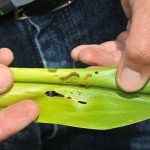
I am continuing to catch a small number of corn earworms in my trap. Usually we talk about earworm moths being attracted to silking corn to lay their eggs. However, moths will lay eggs on whorl stage sweet corn and the larvae can cause damage (Figure 1 and 2). The larvae will often feed inside…Read more about Corn Earworm[Read More]
The cool weather this spring means that many early-planted warm season crops have probably been stressed by cool temperatures more than usual. A number of herbicides labeled for vegetable crops include warnings not to use when the crop is or will be under stress. A stressed crop may not be able to detoxify the herbicide…Read more about Cool Temperatures and Excess Rain may Increase Crop Injury from Labeled Herbicides[Read More]
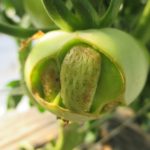
Recent cool weather increases the occurrence of zippering on high tunnel tomatoes. We observed at least 20% of developing fruit (most on the first and second flower clusters) on the variety Mountain Spring showed the zippering symptoms in our high tunnel. A typical symptom of the disorder is a thin, brown, necrotic scar that starts from the…Read more about Tomato Zippering[Read More]
Purdue Extension publication PPP-110 ‘Options for Dealing with a Pesticide Drift Incident’ describes causes and effects of pesticide drift. It discusses actions a vegetable farmer (or anyone) might take if they suspect that herbicide drift may have injured their crop. The first step suggested is to find out what caused the symptoms. The publication explains…Read more about New Purdue Publication About Pesticide Drift[Read More]
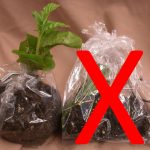
Samples in plug trays, as well as unrooted and rooted cuttings, and plants in pots require extra care when they are packaged for submittal to a diagnostic lab. Before you mail the next sample, please take a few minutes to review these suggestions for packaging and submitting samples. This will help preserve the integrity of…Read more about Tips for Submitting Greenhouse Samples to the Purdue Plant and Pest Diagnostic Lab (PPDL)[Read More]
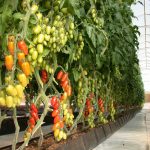
Planting density plays an important role in the optimization of labor efficiency and productivity of your high tunnel. For the purpose of this article I will focus on tomato which is commonly grown as a high value crop on small farming operations. Usually growers select varieties according to customer (market) preference and then try to…Read more about Link between Plant Density, Yield and Revenue from a High Tunnel[Read More]
Purdue University prohibits discrimination against any member of the University community on the basis of race, religion, color, sex, age, national origin or ancestry, genetic information, marital status, parental status, sexual orientation, gender identity and expression, disability, or status as a veteran. This material may be available in alternative formats. 1-888-EXT-INFO Disclaimer: Reference to products in this publication is not intended to be an endorsement to the exclusion of others which may have similar uses. Any person using products listed in this publication assumes full responsibility for their use in accordance with current directions of the manufacturer.