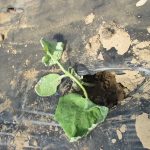
Last week, we received calls from several watermelon growers who reported that their newly planted watermelon seedlings had died (Figure 1). After closely inspecting the affected plants, we did not find any pathogens. This reminded us of what happened to our cucumbers back in early April in our high tunnel. We will review the cucumber…Read more about Establishment Failure of Watermelon and Cucumber Transplants Because of Low Soil Temperatures[Read More]
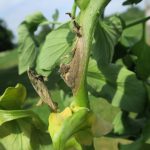
I have observed leaf mold of tomato in greenhouses and high tunnels recently. This article will discuss this disease and management options. In the last issue of the Hotline, I discussed Botrytis gray mold. I noted how gray mold is favored by the cool, cloudy weather we experienced earlier this spring. The warmer and sunnier weather we have…Read more about Leaf Mold of Tomato[Read More]
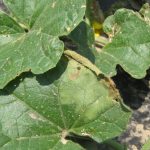
This disease has been observed in the southern part of Indiana. To identify bacterial wilt, look for the characteristic wilt and beetle feeding on the leaves and stem (Figure 1). The bacterium that causes this disease, Erwinia tracheiphila, is spread by the striped or spotted cucumber beetles. Once bacterial wilt is observed in the field, there…Read more about Bacterial Wilt of Cantaloupe[Read More]
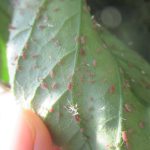
We have begun to receive the first reports of aphid outbreaks in high tunnels on tomato, pepper, and cucumber (Figure 1). Aphids are a very common problem in high tunnels because the covering excludes rainfall, which is a major mortality factor for small insects like aphids. Some growers are interested in using biological control in…Read more about Aphids in High Tunnels[Read More]
I continue to catch low numbers of corn earworm moths in my pheromone trap. Although the numbers are low, growers with very early sweet corn that is in the reproductive stage should be alert for potential damage. The threshold for spraying sweet corn that matures prior to field corn silking is only one moth per…Read more about Corn Earworm[Read More]
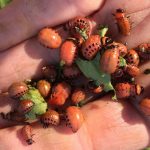
Last week we had a report of an infestation of Colorado potato beetle larvae on tomatoes in a high tunnel (Figure 1). Potato beetles are a pest of most of the solanaceous crops (potato, tomato, eggplant, pepper), but they rarely become a serious problem on tomato in Indiana. In addition, we have not seen them in…Read more about Colorado Potato Beetles on High Tunnel Tomatoes[Read More]
We sometimes hear that excessive nitrogen could delay fruit set, stimulate excessive vine growth, and depress overall yield of pumpkins, but it is often unclear how much nitrogen is too much. This article reviews research on nitrogen fertilizer rates for pumpkins, and discusses the potential factors that might affect the recommended nitrogen rate. In a…Read more about How Much Nitrogen is Too Much for Pumpkins[Read More]
If you visit the Vegetable Crops Hotline on-line, be sure to visit our new addition: Veggie Extras. The articles that you’ll find when you click on the Veggie Extra link include brief observations, photos, research updates or in-depth subjects that we hope the vegetable professional might find interesting. Articles that are in the Veggie Extras…Read more about Veggie Extras[Read More]
Individuals who have visited Dan Egel’s blog will notice a new look when they next visit. All articles have been migrated to a new site that will be maintained on the Vegetable Crops Hotline site. There is no need to change your bookmark and the same URL veggiediseaseblog.org will work. However, the site is new and improved. All of the articles that…Read more about Vegetable Disease Blog[Read More]
Beginning Farmer Tours June 25, 2016: Silverthorn Farm, Rossville. Organic fruits and vegetables, pastured pork and working with restaurants. July 14, 2016: Melon Acres, Oaktown. Community-supported agriculture and agritourism. Sept. 29, 2016: River Ridge Farm, Roann. Four-season vegetable farming, operating an on-farm store, and farm-to-school programs. The tours are free, but registration is required. Registration at https://mdc.itap.purdue.edu/wk_group.asp?wk_group=BeginFarmer For more…Read more about Upcoming Events[Read More]
Purdue University prohibits discrimination against any member of the University community on the basis of race, religion, color, sex, age, national origin or ancestry, genetic information, marital status, parental status, sexual orientation, gender identity and expression, disability, or status as a veteran. This material may be available in alternative formats. 1-888-EXT-INFO Disclaimer: Reference to products in this publication is not intended to be an endorsement to the exclusion of others which may have similar uses. Any person using products listed in this publication assumes full responsibility for their use in accordance with current directions of the manufacturer.