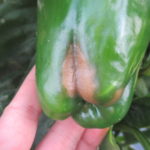
In the past few weeks, we have received several reports about blossom end rot on tomatoes and peppers as the crops start to set fruit. Blossom end rot is a physiological disorder (not an infectious disease) that commonly occurs on tomatoes and peppers. Initial symptoms of the physiological disorder include dark green or brown water-soaked leisure…Read more about Blossom End Rot of Tomato and Pepper[Read More]
Tomato
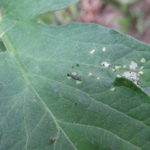
We are seeing small caterpillars feeding on tomato leaves in high tunnels at Pinney Purdue. The first sign may be feeding partially through the leaf, or ‘windowpane’ feeding, or small holes on the leaf. By turning the leaf over we find a yellowstriped armyworm or hornworm (Figures 1 and 2). In the morning, we find…Read more about Caterpillars on High Tunnel Tomatoes[Read More]
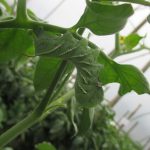
One of the most impressive insect pests that we deal with on vegetables are the hornworms (Figure 1 and 2). These two species, tomato and tobacco hornworm, can reach up to 4 inches long and consume massive quantities of foliage and fruit. In recent years, we have seen damage in high tunnels that is more…Read more about Hornworms[Read More]
I have received some reports of Colorado potato beetles damaging both potatoes and tomatoes, including tomatoes in high tunnels. Both the adults and larvae are voracious feeders. As with most pests, it is best to get potato beetles under control before the populations get too high. Also, killing small larvae is easier than killing large…Read more about Colorado Potato Beetles[Read More]
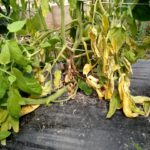
White mold has a large host range including tomatoes (where it may be referred to as timber rot), cucumbers, lettuce and snap beans as well as many more. In this article, I will concentrate on white mold on tomatoes in a greenhouse situation. Although white mold will occur in a field situation, this disease is…Read more about White Mold of Vegetables[Read More]
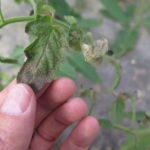
Tomato spotted wilt virus can cause stunting (Figure 1), necrotic ring spots (Figure 2), mottling (Figure 3) or chlorosis (Figure 4). In Figure 5, a pepper plant is shown with a ring-like lesion due to tomato spotted wilt virus. Figure 6 is a photo of a pepper transplant with mottled lesions due to impatiens necrotic…Read more about Photos of Tomato Spotted Wilt and Impatiens Necrotic Spot Virus[Read More]
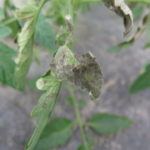
While many virus diseases affect pepper and tomato plants, in the Midwest, the most common virus diseases of these two crops are tomato spotted wilt virus (TSWV) and Impatiens necrotic spot virus (INVV). These diseases are usually observed in greenhouse or high tunnel situations. The two viruses, TSWV and INSV are closely related. In fact,…Read more about Viruses on Greenhouse Tomatoes[Read More]
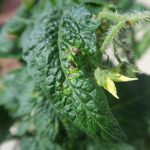
Many Indiana growers may have tomato transplants growing in a greenhouse for field or greenhouse/high tunnel production. The three most likely diseases are bacterial spot, bacterial speck and bacterial canker. This article describes symptoms for these diseases and some management options. While these bacterial diseases thrive in transplant production where plants are often overhead watered, these diseases are…Read more about Tomato Transplant Diseases[Read More]

Effectively managing foliar diseases including late blight (LB), early blight (EB), and Septoria leaf spot (SLS), is one of the biggest challenges facing organic tomato growers. New, resistant hybrid varieties are available, but organic growers often plant heirloom varieties instead because they are perceived to have superior flavor and growers can save seed. Copper fungicides…Read more about The TOMI Project Aims to Help Tomato Growers Better Manage Foliar Diseases[Read More]