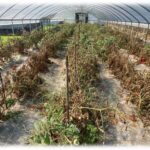
Over the last few years, we’ve heard of 2 or 3 unusual cases of high tunnel tomato producers losing entire crops of their tomatoes, with plants suddenly looking brown and covered in leaf mines/tunnels (Figure 1). After collecting specimens, we’ve confirmed the very hungry and tiny culprit is the caterpillar of the tomato pinworm (Keiferia…Read more about Lookout for Tomato Pinworm: a Rare but Very Hungry Caterpillar that can Devastate Tomatoes[Read More]
Tomato

Bacterial canker has been observed in late season tomato crops. This article will serve as a review of this important disease. The symptoms of bacterial canker vary considerably. In most cases, the edges of the leaves may turn yellow and/or brown. That is, the margins of the leaves may become chlorotic and/or necrotic (Figure 1)….Read more about Bacterial Canker of Tomato[Read More]
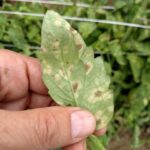
In 2015 and 2018, I observed Cercospora leaf mold of tomato in high tunnel operations. In Hotline articles in those years, I noted that Cercospora leaf mold is normally a subtropical disease. This disease has again been observed in 2021 on tomatoes in high tunnels. I’m still not certain of the importance of this disease…Read more about Tomato Leaf Mold Diseases[Read More]
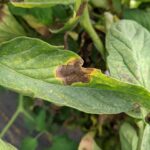
Listed below are select foliar diseases of tomato. Early blight and Septoria leaf blight These diseases are listed together because, from a few paces away, the diseases appear similar. And the management for these diseases is similar. Together these diseases are probably the most common diseases of tomatoes in the field. One of the most…Read more about Foliar Diseases of Tomato[Read More]

Tomatoes cracking in the late stages of ripening (Figure 1) was observed in our field visit. This article discusses conditions that are likely to predispose tomatoes to crack. The cracking that happened recently in open field production is likely associated with the heavy rains. The problem is most observed when a dry period is followed…Read more about Cracking Tomatoes[Read More]
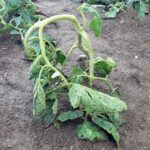
Off-target herbicide movement, whether from on-farm or neighboring farms, is not a new problem. However, in recent years it has been on the top of more minds. Although many crops seem to recover from an off-target herbicide event, vegetative recovery does not always imply that all is well. To illustrate this point, let’s look at…Read more about Herbicide Drift on Tomatoes[Read More]
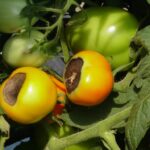
As tomatoes bloom and set fruit it is a good time to review practices for avoiding some common fruit problems. Water management is key to avoiding blossom end rot. Adequate potassium is important to reduce yellow shoulder and internal white tissue. This article provides more information on these topics, and includes some information previously published…Read more about Reducing Blossom End Rot and Yellow Shoulder/Internal White Tissue in Tomato[Read More]
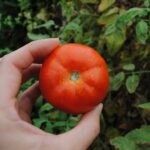
To regular readers of the Vegetable Crop Hotline, it may seem that we include an article about tomato spotted wilt virus every year out of custom. However, we have again observed large outbreaks of this disease. Please read the article below carefully if you raise tomato transplants or mature tomatoes in a greenhouse or high…Read more about Tips for Managing Tomato Spotted Wilt Virus (TSWV)[Read More]
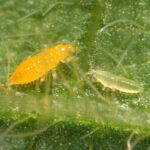
Tomato spotted wilt virus (TSWV) is a plant disease caused by a virus that infects more than 1,000 species of plants, including ornamentals and vegetables. Visual symptoms of TSWV vary depending on the plant that is infected, but general characteristics include yellow or brown ringspots on fruit and small, dark-colored ringspots on foliage that may…Read more about Tips for Managing Tomato Spotted Wilt Virus (TSWV)[Read More]
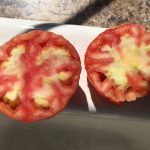
A common problem tomato growers face this time of year are fruit defects caused by high temperatures. Heat stress on tomatoes can lead to reduced yield and abnormal fruit development. The common physiological disorders on fruit development under heat stress include yellow shoulder, internal white tissue, and blotchy ripening. In a recent presentation by Gordon…Read more about Tomato Varieties Differ in Susceptibility to Internal White Tissue Disorder[Read More]