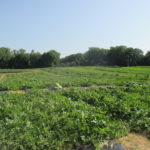
This article addresses considerations of using grafted watermelon plants in Indiana. Choosing rootstocks Interspecific hybrid squash is the most widely used watermelon rootstock. Many cultivars of the hybrid squash rootstocks that have been developed by different companies, share similar genetic background and thus similar characteristics. All of them have outstanding resistance to Fusarium wilt, but,…Read more about Using Grafted Watermelon Plants in Indiana[Read More]
Watermelon
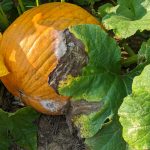
Phytophthora blight was a serious disease this past season. As a result, I have had many questions about managing this disease. The following article is an update of a previous article on this subject. The questions I have been asked have ranged from what do I spray to how does this disease work? Therefore, I…Read more about Phytophthora Blight of Cucurbits[Read More]
Thanks to growers’ collaboration and help from Superior Ag, we collected plant tissue samples from 12 watermelon fields at different crop growing stages in Southern Indiana in the 2020 season. In this article, I want to discuss two of the issues that standout from these tests. One is the generally low or deficient Magnesium (Mg)…Read more about Survey of Watermelon Nutritional Status in Southern Indiana — Magnesium and Potassium[Read More]
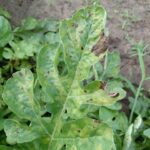
Downy mildew has been observed in LaPorte County in northern Indiana on cucumber. In addition, downy mildew on cucumber has been reported in southern Kentucky and on watermelon in the Kansas City area of Kansas. Growers in northern Indiana should manage for downy mildew on valuable cucurbit crops (Figure 1). Growers throughout the state should…Read more about Cucurbit Downy Mildew[Read More]

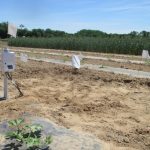
About half of the watermelon fields in our area are not equipped with supplemental irrigation. Watermelon production in these fields is therefore dependent exclusively on rainfall. In fields where supplemental irrigation is available, drip irrigation under black plastic mulch is the most commonly used system. Overhead irrigation through central pivot is also used in some…Read more about Considerations for Irrigation Management in Watermelon Production[Read More]
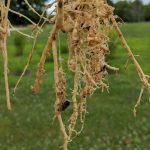
On a sandy hillside in a watermelon field, we noted vines that, from a distance, appeared undersized compared to the vines in the flats. Upon closer inspection, some of the vines had either wilted or a portion of the plant had wilted. The wilted vines had discolored vascular tissue. These vines were affected by Fusarium…Read more about Root-knot Nematode of Watermelon[Read More]
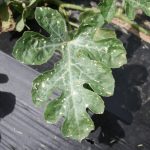
What is causing the spots on the watermelon leaf? A) anthracnose B) early blight C) a contact herbicide The answer is that the leaf above has been affected by a contact herbicide. The herbicide caused lesions upon contacting the leaf. However, there was no growth of the lesion and no yellowing of the leaf…Read more about Answer to Question from Last Issue (6-18-2020)[Read More]
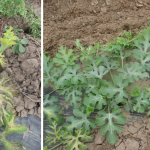
Watermelon is best grown at temperatures around 80-90°F. Temperatures above 90°F reduce the growth rate; above 105°F may cause plant injury. Temperatures below 42°F result in watermelon chilling injury; below 32°F will kill watermelon plants. Extended cool days that lead to soil temperatures dropping into lower 50°F can also kill watermelon seedlings. Using low tunnels is…Read more about Be Cautious When Using Low Tunnels for Early Watermelon Planting[Read More]
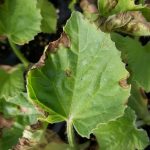
In the last issue of the Vegetable Crops Hotline, I wrote an article about common diseases of cantaloupe and watermelon transplants. Based on the samples I have received over the last few days, I would like to write about a disease that is not usually a problem: angular leaf spot. Angular leaf spot affects all…Read more about Angular leaf spot of Cucurbits[Read More]