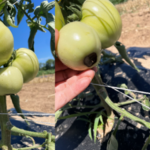
At Southwest Purdue Ag Center (SWPAC) and Pinney Purdue Ag Center (PPAC), we demonstrate irrigation impacts on several fruiting vegetable crops. Tomato, pepper, eggplant, watermelon, and cantaloupe are planted on plastic-covered beds with drip tapes. They grow on beds side-by-side with and without irrigation. We used two approaches to schedule irrigation, one bed is irrigated based on…Read more about Irrigation Demonstration Update June 25[Read More]
Watermelon

Thanks to my University of California Cooperative Extension colleagues, I visited central valley vegetable production last week. Undoubtedly, I learned a lot on this trip. I want to share what I learned with Indiana growers in a few newsletter articles. This short article highlights two things I saw farmers use to extend early-season crop production….Read more about Season Extension Strategies—What I learned in a CA trip[Read More]
The author of this article, Dan Egel, retired from Purdue University in February 2024. MELCAST is a weather-based disease-forecasting program that helps growers schedule foliar fungicide applications for watermelon and cantaloupe. MELCAST stands for MELon disease for CASTer. This program, designed by Dr. Rick Latin, Emeritus Professor of Plant Pathology at Purdue University, keeps track of weather conditions so…Read more about MELCAST[Read More]
Course: Online PCQI Certification – Watermelon Packing Dates: May 5 & May 6, 2022 Times: 8:00 am – 6:00 pm EST Online Platform: Zoom Cost: $1000.00 each participant To register: pcqiclasses@gmail.com or text 561-261-9747 Course Info: Kiley will lead a VIRTUAL but interactive training session (via ZOOM) across two days from 8:00 am – 6:00 pm each day….Read more about Online PCQI Food Safety Certification[Read More]
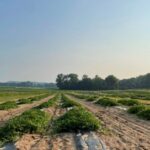
A large proportion of watermelon acres in Indiana are not currently using drip irrigation. Farmers may choose not to use drip irrigation because precipitation is usually abundant in most years for watermelon production. There is a desire to reduce costs and/or fear that over-irrigation may increase the risk of mature watermelon vine decline, a disease…Read more about Research Update on Nitrogen Management in Non-Irrigated Watermelon Production[Read More]

Tell us about your opinions on vegetable grafting practices All growers are eligible whether you use vegetable grafting practices or not. Researchers at the University of Florida, in collaboration with Clemson University, North Carolina State University, The Ohio State University, Pennsylvania State University, Kansas State University, Washington State University, University of Arizona, University of California, Davis, and USDA – Agricultural Research…Read more about Vegetable Grafting Survey[Read More]
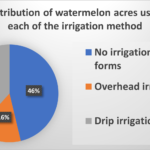
At the 2022 Southwest Indiana Melon and Vegetable Growers Annual Meeting, 17 watermelon farmers and 2 agricultural professionals shared their irrigation and fertilization management practices used for watermelon production in Indiana. These individuals grow or provide services for watermelon acres from less than 50 acres up to 2,000 acres over the past five years. We…Read more about Watermelon Irrigation and Nitrogen Fertilization Methods Commonly Used in Indiana[Read More]
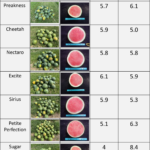
We conduct standard seedless watermelon variety trials at Southwest Purdue Agricultural Center each year. In a separate trial, we evaluate mini seedless watermelon varieties. Mini watermelons refer to fruit ranging from 4.4 to 8.8 lbs, although the industry considers 6-7 lbs fruits ideal. Fruit in a wide range of sizes is suitable to sell at…Read more about Mini Seedless Watermelon Varieties[Read More]
Date: November 18, 2021, 5:00 pm (EST) Location: 4207 Purdue Rd, Vincennes, IN 47591. Purdue Extension Food Safety Training Hub, in the newly constructed Vincennes University Agricultural Center, located on highway 41 adjacent to Southwest Purdue Agriculture Center. The Southwest Indiana Melon and Vegetable Growers Winter Meeting will be back in person in 2021! Note the new…Read more about Southwest Indiana Melon and Vegetable Growers Winter Meeting[Read More]
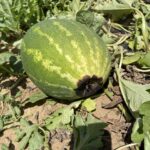
Supported by Indiana Vegetable Growers Association and Illiana Watermelon Association, a collaborative project between Purdue University and Michigan State University that aims to help watermelon farmers improve irrigation management was recently funded. In this project, the team will conduct the scientific experiment at the Southwest Purdue Agricultural Center to test currently used irrigation management tools,…Read more about Collaboration between Purdue University and Michigan State University to Improve Irrigation Management in Indiana Watermelon Production[Read More]