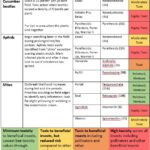
Unfortunately, pests don’t know when to take the day off. Even though we have bees in the field and watermelons reaching peak bloom, we still need to watch out for pest infestation and disease outbreaks. First and foremost, scouting fields to monitor pests will ensure that infestations never reach high enough populations to threaten yield….Read more about Spray Less, Pay Less, and Get Better Control of Your Arthropod Pests[Read More]
Watermelon
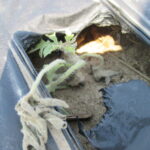
In early May, we had an extended cold period with daily average air temperatures in the 50s°F. Min temperatures are in the 40s°F, some nights even upper 30s°F. In most areas in southern Indiana, it is fortunate we did not encounter a frost with temperature dropped below 32°F, but the low temperature for the extended…Read more about Why do Watermelon and Melon Plants Wilt?[Read More]
MELCAST is a weather-based disease-forecasting program that helps growers schedule foliar fungicides applications for watermelon and cantaloupe. MELCAST stands for MELon disease for CASTer. This program, designed by Dr. Rick Latin, Professor of Plant Pathology at Purdue University, keeps track of weather conditions so that cantaloupe and watermelon growers can apply foliar fungicides to their…Read more about MELCAST 2021[Read More]
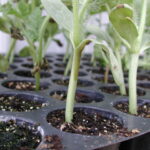
Many cantaloupe and watermelon growers are either growing transplants in a greenhouse or are expecting delivery of transplants in the next few weeks. Either way, growers should inspect transplants for disease before planting in the field. Below I will describe several common transplant diseases of cantaloupe and watermelon as well as management options. Gummy stem…Read more about Cantaloupe and Watermelon Transplant Diseases[Read More]

The Annual Fall/Winter Meeting of the Southwest Indiana Melon and Vegetable Growers is scheduled on Monday, November 30, 2020, 3:00 pm – 5:00 pm (EST). This meeting will be held online this year because of COVID-19 restrictions. Dr. Wenjing Guan and Dr. Dan Egel will discuss the results of the 2020 watermelon and cantaloupe variety…Read more about Southwest Indiana Melon and Vegetable Growers Winter Meeting[Read More]
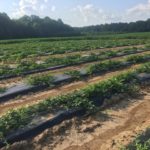
Thanks to growers’ collaboration and help from Superior Ag, we collected plant tissue samples from 12 watermelon fields at different crop growing stages in Southern Indiana in the 2020 season. In a previous article, we discussed results about magnesium and potassium. In this article, we will discuss another nutrient, Sulfur (S). Sulfur deficiency has become…Read more about Survey of Watermelon Nutritional Status in Southern Indiana – Sulfur[Read More]
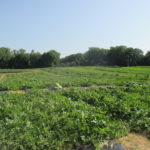
This article addresses considerations of using grafted watermelon plants in Indiana. Choosing rootstocks Interspecific hybrid squash is the most widely used watermelon rootstock. Many cultivars of the hybrid squash rootstocks that have been developed by different companies, share similar genetic background and thus similar characteristics. All of them have outstanding resistance to Fusarium wilt, but,…Read more about Using Grafted Watermelon Plants in Indiana[Read More]
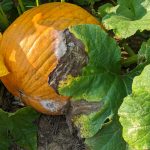
Phytophthora blight was a serious disease this past season. As a result, I have had many questions about managing this disease. The following article is an update of a previous article on this subject. The questions I have been asked have ranged from what do I spray to how does this disease work? Therefore, I…Read more about Phytophthora Blight of Cucurbits[Read More]
Thanks to growers’ collaboration and help from Superior Ag, we collected plant tissue samples from 12 watermelon fields at different crop growing stages in Southern Indiana in the 2020 season. In this article, I want to discuss two of the issues that standout from these tests. One is the generally low or deficient Magnesium (Mg)…Read more about Survey of Watermelon Nutritional Status in Southern Indiana — Magnesium and Potassium[Read More]
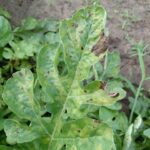
Downy mildew has been observed in LaPorte County in northern Indiana on cucumber. In addition, downy mildew on cucumber has been reported in southern Kentucky and on watermelon in the Kansas City area of Kansas. Growers in northern Indiana should manage for downy mildew on valuable cucurbit crops (Figure 1). Growers throughout the state should…Read more about Cucurbit Downy Mildew[Read More]