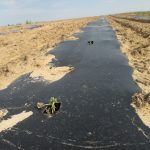
In the past week, we have observed a few cases where newly planted watermelon seedlings were severely damaged or dead (Figure 1). In some fields, we observed rotted roots and lower stems caused by fungal pathogens. However, such diseases were in response to the cold soils and would not normally cause problems in warm soils….Read more about Low Temperature Caused Watermelon Establishment Failure[Read More]
Watermelon
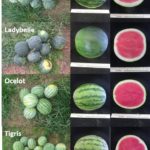
Watermelon variety trials are conducted every year at the Southwest Purdue Agricultural Center in Vincennes, IN. In the 2018 trials, it included 38 standard-size seedless watermelon cultivars and 10 personal-size watermelons. This article discussed the top yielding varieties in our trials in 2018. The full report of the variety trials, and information about the previous…Read more about Watermelon Cultivar Update from the 2018 Indiana Watermelon Variety Trial[Read More]
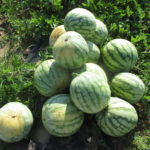
With the growing interest from consumers looking for new, unique products, yellow– and orange-flesh watermelons might create opportunities for small-sized growers to differentiate their products. This article answers a few questions you may have about growing and marketing these unique type of watermelons. Yellow and orange-flesh watermelons usually have narrow strips with varying degree of green…Read more about Yellow- and Orange-flesh Watermelons[Read More]
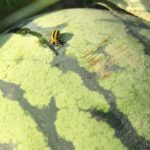
Striped cucumber beetle can be a significant pest in watermelon production systems. These pests can cause feeding damage to roots, stems, leaves, and flowers of plants as well as the watermelon fruit itself (Figure 1). In large enough densities, this damage can lead to economic loss. The economic threshold for striped cucumber beetles in watermelon…Read more about Striped Cucumber Beetles: Densities and Effective Scouting in Watermelons[Read More]
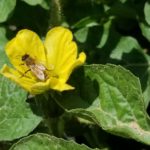
Insecticides are often needed to control pests in vegetable crops, but in crops that require pollinators we often worry about the impact those insecticides may have on those pollinators (Figure 1). In the summer of 2018, a team of researchers at Purdue University explored the effects of insecticide applications on watermelon yield across Indiana, considering…Read more about IPM Revisited: A Cost-effective Solution for Balancing Pest and Pollinator Management[Read More]
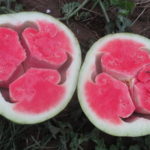
Hollowheart of watermelons is a physiological fruit disorder. Flesh separates inside of the fruit, typically forming three gaps (Figure 1 and 2). In severe cases, hollowheart could cause watermelon load rejection. Watermelon fruit that has hollowheart tends to be triangular shaped. Poor pollination is the primary reason causing hollowheart. Scientists were able to prove that seedless watermelons…Read more about Hollowheart of Watermelons[Read More]
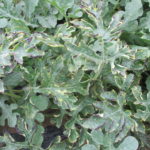
Watermelon harvest is in full swing in southern Indiana. At this time, we frequently see many types of leaf symptoms. Some of them are caused by foliar diseases, such as anthracnose, Alternaria leaf blight and gummy stem blight. These diseases require special attention, normally in the form of fungicide sprays, to slow spread of the…Read more about Not All the Watermelon and Cantaloupe Leaf Symptoms are caused by Pests[Read More]
MELCAST is a weather-based disease-forecasting program that helps growers schedule foliar fungicides. MELCAST stands for MELon disease forCASTer. This program, designed by Dr. Rick Latin, Professor of Plant Pathology at Purdue University, keeps track of weather conditions so that cantaloupe and watermelon growers can apply foliar fungicides to their crops when they are most needed….Read more about MELCAST 2018[Read More]
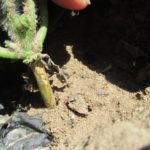
This article provides more detailed information about this herbicide. How does Chateau® herbicide work Chateau® is a group 14 mode-of-action herbicide. Compounds in this group are most active on broadleaf weeds. Before Chateau® became available, no other preemergence herbicide with the same mode of action was labeled for use in watermelons and cantaloupes. The active…Read more about Chateau Herbicide for Use in Melon Production[Read More]
Chateau SW® herbicide now has a 24(c) special local needs label for cucurbits. This product is produced by Valent, but the label is held by the Indiana Vegetable Growers Association (IVGA). To obtain a label, one must be a member of the IVGA, pay an annual $100 processing fee, read and understand the ‘conditions for…Read more about Chateau Herbicide SW 24(c) label[Read More]