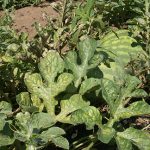
We have received a number of reports of outbreaks of spider mites, primarily in watermelons and in high tunnels. The problems in high tunnels are not unexpected because one of the primary causes of mortality in mite populations is rainfall washing them off the plants and, of course, that is lacking completely in high tunnels….Read more about Spider Mites[Read More]
Watermelon
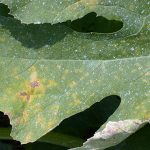
On July 22, I announced that downy mildew had been observed on watermelon in Knox County in southwestern Indiana. This article https://ag.purdue.edu/arp/swpap/VeggieDiseasesBlog/Lists/Posts/Post.aspx?ID=48 describes the outbreak and management options. Below, I will discuss the whereabouts of additional downy mildew outbreaks on cucurbits. Downy mildew has now been reported on cucumber in Knox and La Porte County Indiana….Read more about Downy Mildew Update[Read More]
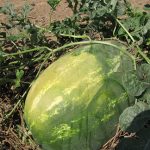
Loss of foliage due to poor growing conditions or disease can cause fruit to be exposed to the sun. Hot temperatures and direct sunlight can lead to areas of the fruit that appear bleached or sunburned. Sunburned fruit may not be marketable. To reduce the probability sunburned fruit, every effort should be made to maintain foliage…Read more about Sunburn on Vegetables[Read More]
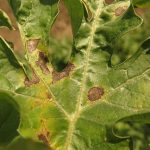
This disease has been observed on watermelon in Knox County. The following article will discuss the symptoms, biology and management of downy mildew of cucurbits. Symptoms. The symptoms of downy mildew vary depending on the host. On watermelon, the lesions start out as chlorotic (yellow) areas that become round and necrotic (brown/black) areas surrounded by…Read more about Downy Mildew of Watermelon[Read More]
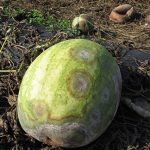
Most growers first notice this disease when large, soft areas develop on mature watermelon fruit. These lesions can be several inches across and are often covered with a white mold. The lesions usually form first on the bottom of the fruit, close to where the fruit comes into contact with the soil. Further development of the…Read more about Phytophthora Fruit Rot of Watermelon[Read More]
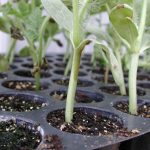
Most watermelon growers are in the process of placing transplants in the field. I have received several commercial samples of transplants still in trays prior to out-planting. The two diseases I have observed so far are gummy stem blight and bacterial fruit blotch. Below, I discuss these two diseases as well as management options. Gummy stem blight on…Read more about Watermelon Disease Update[Read More]
Many cantaloupe and watermelon growers have planted transplants in the field or will soon. A question many growers often have is when and how should one apply fungicides. Applying fungicides according to a weather-based system is easy for cantaloupe and watermelon growers. MELCAST was developed at Purdue University by Rick Latin to allow growers to…Read more about MELCAST[Read More]
For most insect pests, we have some viable options to manage them organically. For years we have been looking for an organic solution for striped cucumber beetle and bacterial wilt on melons and cucumbers. It appears that we now have a viable option. There is a relatively new product, Cidetrak D, manufactured by Trece, which…Read more about Organic Control of Striped Cucumber Beetles[Read More]
In December 2014, I described the ‘Yearbook of Agriculture, 1928”. In that blog, I wrote about processing tomato production in 1925 and 2013 (the ‘Yearbook of Agriculture, 1928’ lists data back to 1925). Today, I would like to discuss cantaloupe and watermelon production. Unfortunately, yields posted in the “Yearbook” are in different units than in…Read more about Cucurbit Production in Indiana: 1925 and 2013[Read More]
Read more about Cucurbit Production in Indiana: 1925 and 2013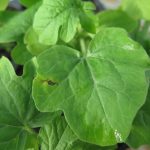
Bacterial fruit blotch is a disease that can affect most cucurbits (see Figure 1). However, the symptoms are most often observed on watermelon. A brief description of this disease and some photos can be found here. This article will introduce new recommendations for this disease in Indiana. Details of these recommendations can be found in the Midwest Vegetable Production…Read more about Bacterial Fruit Blotch Update[Read More]