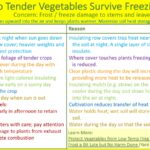
There is a frost and freeze warning for 4/20, 4/21, 4/22. Vegetable growers should be prepared to take protective actions on early-planted warm-season vegetables (tomato, cucumber, pepper, summer squash, bean etc.). For high tunnel growers, medium-weight floating row covers should provide sufficient protection. Growers should close the structure when inside temperatures drop below 80°F to…Read more about Frost and Freeze Warning[Read More]
Climate and Weather
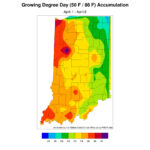
March wrapped up as one of Indiana’s wettest (44th wettest out of 126 years) and warmest (16th warmest). It was marked by unusually warm days and then cool days. Was it ever just average? Certainly, most days fell within the climatological range of temperatures. Precipitation seemed to be partial to the southern part of the…Read more about April Showers or Lingering Drought?[Read More]
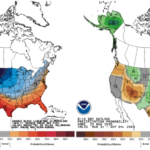
After the last several weeks of predominantly dry conditions, the national climate outlooks are finally showing confidence that temperatures should start shifting to cooler than normal and precipitation will be wetter than normal (Figure 1). Hurricane Laura will definitely help the precipitation side of that prediction with current tracks having the strongest rainfall amounts in…Read more about Cooler, Wetter Conditions Expected Over Next Several Weeks[Read More]
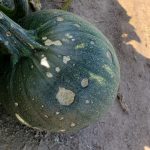
Question: What happened to these fruit? Answer: Hail damage. A storm that happened in middle July brought hail to parts of Indiana. Hail hit small fruit, and damage became pronounced as fruit grow. More information about the damage to vegetable crops can be found in the article Hail Damage published in Vegetable Crops Hotline Issue…Read more about Answer to Question from Last Issue (8-13-2020)[Read More]
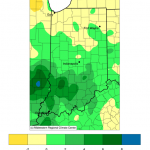
Rain moved across Indiana earlier this week, bringing much-needed precipitation to the northern counties. Unfortunately, the 30-day rainfall totals are still up to two inches below normal (Figure 1). The southern and southwestern counties are well above normal and could likely use a break for the next few days! Good news for those tiring of…Read more about Monitoring Potential Evapotranspiration Across Indiana[Read More]
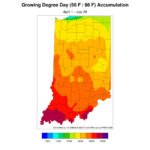
On July 16th, the national Climate Prediction Center released the climate outlooks for August (Figure 1) and the August-September-October (Figure 2) period. Both outlooks are indicating a significant probability for above-normal temperatures. Precipitation is likely to be above normal for the southern two-thirds of Indiana in August, but there is little-to-no guidance for the 3-month,…Read more about Indiana Climate and Weather Outlook[Read More]
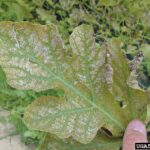
When ground level ozone is high enough to trigger an Air Quality Action Day alert from the Indiana Dept. of Environmental Management (IDEM) it is a reminder that crops may be injured by ozone. A number of areas around the state have experienced alerts in recent days, e.g. July 14 in S. Indiana. If crops…Read more about Ozone Injury on Vegetable Plants[Read More]
(This article is modified from one published in issue 537 of this newsletter written by Sarah E. Hulick and Steve Reiners, Department of Horticulture Science, Cornell University, NYSAES. Liz Maynard also contributed to this article.) Recent storms have brought hail to parts of Indiana. Loss of yield and quality in vegetable crops due to hail…Read more about Hail Damage[Read More]
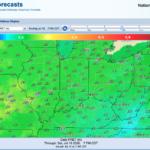
The past 30 days have been met with warmer than normal temperatures in the northern counties and drier than normal conditions throughout most of the state (Figures 1 and 2). This warm and dry environment is conducive to developing drought – particularly with the increased evapotranspiration rates. While climate outlooks are calling for increased confidence…Read more about Reference Evapotranspiration Forecasts across Indiana[Read More]
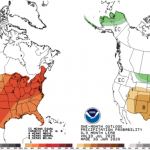
The roller coaster ride of Indiana weather continues. Things were drying out across the state with signs of browning lawns, rolling vegetation leaves, and lowering pond and stream levels. Then the rains came. Most of the state received between 2 and 3 inches of precipitation from June 20 through 29th – with wetter areas to…Read more about Outlooks Showing Confidence for Below-normal Precipitation[Read More]