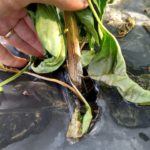
Southern blight of pepper and tomato thrives under hot, dry conditions. Usually, such conditions are more likely in August. Production under tunnels may contribute to the dry conditions that influences southern blight. This article will discuss the symptoms, biology and management of southern blight of tomato. Southern blight has a wide host range affecting many vegetable,…Read more about Southern Blight of Pepper and Tomato[Read More]
Dan Egel

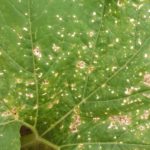
I have observed this disease in scattered commercial pumpkin and squash fields across Indiana. Bacterial leaf spot of pumpkin is perhaps the most serious disease of pumpkin in Indiana today. Symptoms: Bacterial spot causes ⅛-¼ inch angular leaf lesions that are white to light brown in color (Figure 1). These leaf lesions may be accompanied…Read more about Bacterial Spot of Pumpkin[Read More]
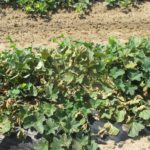
Manganese toxicity is a common problem for cantaloupes growing in sandy soils across southwestern Indiana. Because symptom of manganese toxicity can easily be confused with foliar diseases, growers may misdiagnose the problem and waste fungicides by spraying for nonexistent diseases. As we now know that manganese toxicity is a nutrient related disorder caused by low…Read more about Manganese Toxicity on Cantaloupes[Read More]
I have observed very few foliar diseases of cucurbits this season. However, I have had several worried phone calls about these diseases, so here is an update. Alternaria leaf blight-this disease is caused by a fungus that survives in crop residue. It usually is not an important disease. However, Alternaria can cause brown lesions with…Read more about Foliar Disease of Cucurbit Update[Read More]
Since we are well into fungicide application time, below I have listed 10 rules that will help vegetable growers apply fungicides effectively and safely. Apply fungicides prior to the development of disease. Although many fungicides have systemic (“kick back”) action they will not completely eradicate diseases after they have started. And by the time a single…Read more about 10 Useful Rules for Fungicide Application[Read More]
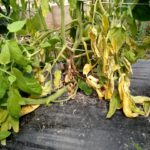
White mold has a large host range including tomatoes (where it may be referred to as timber rot), cucumbers, lettuce and snap beans as well as many more. In this article, I will concentrate on white mold on tomatoes in a greenhouse situation. Although white mold will occur in a field situation, this disease is…Read more about White Mold of Vegetables[Read More]
Cantaloupe, watermelon and pumpkin growers can use information in the Midwest Vegetable Production Guide for Commercial Growers (ID-56) to help determine what fungicides to apply. The MELCAST system (see accompanying article in this issue) can be used to help to decide when fungicides should be applied. I have developed two fungicide schedules that I hope will help…Read more about Cucurbit Fungicide Schedules[Read More]
Many cantaloupe and watermelon growers have transplanted seedlings to the field. Soon, these growers will have questions about what and when to apply fungicides. The article below in this issue of the Vegetable Crops Hotline will address what fungicides to apply (Fungicides schedules for cucurbits). This article discusses when to apply fungicides with the MELCAST system….Read more about MELCAST 2017[Read More]
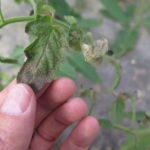
Tomato spotted wilt virus can cause stunting (Figure 1), necrotic ring spots (Figure 2), mottling (Figure 3) or chlorosis (Figure 4). In Figure 5, a pepper plant is shown with a ring-like lesion due to tomato spotted wilt virus. Figure 6 is a photo of a pepper transplant with mottled lesions due to impatiens necrotic…Read more about Photos of Tomato Spotted Wilt and Impatiens Necrotic Spot Virus[Read More]
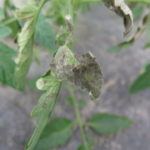
While many virus diseases affect pepper and tomato plants, in the Midwest, the most common virus diseases of these two crops are tomato spotted wilt virus (TSWV) and Impatiens necrotic spot virus (INVV). These diseases are usually observed in greenhouse or high tunnel situations. The two viruses, TSWV and INSV are closely related. In fact,…Read more about Viruses on Greenhouse Tomatoes[Read More]