Cover crops should be killed at least a couple of weeks before planting vegetables. That will give the cover time to partially decompose, and time for any cutworm larvae that may be in the crop to die or pupate. If wet weather delays killing or incorporation of cover crops, the time between incorporation and planting…Read more about Managing Cover Crops in Spring[Read More]
Found 129 Articles
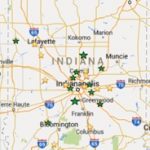
Background. Rapid growth in the craft beer industry is stimulating Indiana’s economy and creating an opportunity for Indiana farmers to start growing hops. In 2012, the Indiana craft brewing industry contributed over 600 million dollars to the state’s economy. The industry continues to grow, increasing from 63 breweries in 20131 to nearly 100 in 2015,…Read more about State of the Indiana Hops Industry[Read More]
(Information provided by Office of the Indiana State Chemist, 765-494-1492, www.oisc.purdue.edu) The Indiana Pesticide Clean Sweep Project designed to collect and dispose of suspended, canceled, banned, unusable, opened, unopened or just unwanted pesticides (weed killers, insecticides, rodenticides, fungicides, miticides, etc.) is being sponsored by the Office of Indiana State Chemist (OISC). This disposal service is…Read more about Plan to Dispose of Unwanted Pesticides[Read More]

Purdue Extension is starting the Indiana Food Hub Network this year. So what’s a food hub? The USDA working definition is “a centrally located facility with a business management structure facilitating the aggregation, storage, processing, distribution, and/or marketing of locally/regionally produced food products.” Extension educator Roy Ballard, who is workkng with Local Food Coordinator Jodee…Read more about Indiana Food Hub Email List[Read More]
While the hard copy of the Midwest Vegetable Production Guide for Commercial Growers 2015 (ID-56) has been available since early January, the on-line version is updated as needed. Below I outline the latest changes. Page 40, Table 16. Several insecticide products were added to the “Insecticide Labeling for Greenhouse Use” table. Page 100, Cucurbit chapter….Read more about Updates to the Midwest Vegetable Production Guide, 2015[Read More]
In December 2014, I described the ‘Yearbook of Agriculture, 1928”. In that blog, I wrote about processing tomato production in 1925 and 2013 (the ‘Yearbook of Agriculture, 1928’ lists data back to 1925). Today, I would like to discuss cantaloupe and watermelon production. Unfortunately, yields posted in the “Yearbook” are in different units than in…Read more about Cucurbit Production in Indiana: 1925 and 2013[Read More]
Read more about Cucurbit Production in Indiana: 1925 and 2013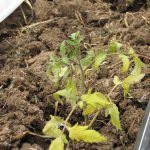
Sometimes newly transplanted crops don’t take off like we’d expect. Consider the newly transplanted tomato seedlings in these images. In Figure 1, lower leaves are chlorotic (yellow) and leaflet edges and leaves curl downward. In Figure 2, lower leaves are chlorotic or bleached and some had necrotic (dead) spots. In Figure 3, some leaves have…Read more about Too Much Fertilizer for Transplants?[Read More]
Two USDA grant programs may be of interest to vegetable growers or grower organizations. The Rural Energy for America Program helps growers and small rural business improve energy efficiency, or purchase or install renewable energy systems. The program includes guaranteed loan financing and grant funding. For more information see the USDA website at www.rd.usda.gov/programs-services/rural-energy-america-program-renewable-energy-systems-energy-efficiency or…Read more about Grant Programs: Rural Energy for America and Specialty Crop Block Grant[Read More]
For those who receive hard copies of the Vegetable Crops Hotline by US Mail, this will be the last issue mailed unless you have renewed your subscription for 2015. You may renew by 1) mailing subscription form included in this issue with payment, or 2) joining or renewing membership in the Indiana Vegetable Growers Association…Read more about Have You Renewed your Hard Copy Subscription yet?[Read More]
Purdue University prohibits discrimination against any member of the University community on the basis of race, religion, color, sex, age, national origin or ancestry, genetic information, marital status, parental status, sexual orientation, gender identity and expression, disability, or status as a veteran. This material may be available in alternative formats. 1-888-EXT-INFO Disclaimer: Reference to products in this publication is not intended to be an endorsement to the exclusion of others which may have similar uses. Any person using products listed in this publication assumes full responsibility for their use in accordance with current directions of the manufacturer.